Blog

Outdoor and adventure films — Worth a watch
A list of outdoor and adventure-related films I've enjoyed watching on the internet.
A categorised list of outdoor and adventure films which I’ve enjoyed watching and would recommend, having viewed each many times over, either for the characters, storyline, scenery or the cinematography, but usually a combination of all four. I’ll edit the list occasionally as I find new films, or to update broken links.
Climbing and mountaineering

Andy Turner arranging ropes during a winter climb in Cairngorms National Park, Scotland
A Line Across The Sky — Primarily a first person POV film of Tommy Caldwell and Alex Honnold enoying what included, I’d imagine, lots of their own type of ‘type-2’ fun as they become the first climbers to traverse the long-coveted (but little attempted) 5km long skyline of the Chaltén/Fitzroy massif in Argentine Patagonia. The relaxed attitude and camaraderie of the two friends I’d imagine completely belies the serious of their situation and the prodigious skills needed for their success.
Cerro Torre— The late, great David Lama solving the puzzle on the vertiginous headwall of Cerro Torre, a striking, ice-encrusted rock spire on the edge of the Southern Patagonian Ice Cap in Los Glaciares National Park, Argentine Patagonia. (See Werner Herzog’s ‘Scream of Stone’ for context). The helicopter shots as Lama and his climbing partner Peter Ortner are on route are sublime. (A separate film, Cumbre’, which documents Marco Pedrini’s solo climb of Cerro Torre in 1985 is also worth a watch).
China Jam —I’ve watched a few films from Belgian brothers Nico and Olivier Favresse and their friends, including Sean Villaneuva O’Driscoll, whose idea of fun is hard, adventurous free climbing on difficult mountains around the world (including Baffin Island, Greenland and Patagonia). In China Jam, Evrard Wendenbaum joins them as they explore the Tien Shan mountains on the Kyrgyz-Chinese border and make a first ascent in deteriorating conditions of the South-East Pillar of Kyzyl Asker (5842m). (See more from the team in Adventures of the Dodo and Vertical Sailing — Greenland).
Cold — The kickstarter to Cory Richard’s career as a National Geographic photographer as he, Simone Moro and Denis Urubko become the first people to climb an 8000m peak in Pakistan in winter.
Cold Haul — A film by big-wall specialist and the self-proclaimed ‘second-best climber in Hull’, this self-shot effort by UK climber Andy Kirkpatrick and fellow alpinist Ian Parnell documents their successful ascent of the Lafaille route on the west face of Aiguille du Dru in winter, high above Chamonix in France. An entertaining film that provides a glimpse into the technicalities of top-grade aid climbing but also visualises the harsh reality of what it takes to look after yourself whilst climbing and sleeping on an alpine wall in winter.
Dawn Wall — The climbing equivalent of a buddy movie as Tommy Caldwell recruits Kevin Jorgensen for his 7-year project to free climb the Dawn Wall, a 1000m-high, hugely technical climbing route on El Capitan in Yosemite National Park in America. Possibly unique as being the only climb to be beamed live to an audience of (perhaps) millions, when the mainstream media took interest and set up camp in Yosemite meadows. (The film by the crew behind the scenes of the Dawn Wall movie is also worth a watch).
Desert Ice—A film directed by Keith Ladzinski which showcases the adventure, excitement, effort and fun involved in two climbers finding and climbing steep ice on the walls of the steep slot canyons in South-West Utah in the USA. (Scott Adamson, one of the main protagonists in Desert Ice and who I believe was a friend of Keith’s, is sadly presumed dead after he went missing in 2016 during an first ascent attempt on the Ogre II in Pakistan, along with climbing partner Kyle Dempster. For a taster of who Kyle himself was as a person, see his self-shot travel-log ‘The Road from Karakol’).
Dirtbag: The Legend of Fred Beckey — Fred Beckey I’m surmising was someone who the people who knew him either really admired, liked, disliked or were hugely frustrated by. A prolific climber and a life-long ‘dirtbag’, all the way to his death in 2017 at age 94 years old, Beckey put up hundreds of first ascents in the North Cascades mountains in Washington state and other mountain regions, documenting these in a number of books he wrote, with a mindset laser-focused on climbing. A fascinating film about someone I’d heard lots about but knew little.
Free Solo — An expertly-shot, multi-award-winning epic (it won categories at both the 2019 Oscars and Emmys) this now well-known film showcases Alex Honnold’s jaw-dropping solo climb of the 2307m high El Capitan in Yosemite National Park. I watched it three times in the first week of its release and it’s such a stunning achievement, especially when you consider Alex’s mental strength, that, given climbing is still a fairly niche activity, it will likely never get Alex the full respect he deserves. View on a big screen if you can.
Higher Ground— A collection of films about climbing and mountain culture by Chris Alstrin and Alex Lavigne which narrates for the viewer a variety of different climbing specialisms, including technical mixed climbing, solo ice climbing and winter alpine climbing. I’ve especially enjoyed returning to the footage of Sean Isaac and Shawn Huisman repeating their first ascent of ‘Cryophobia’, a 225m route graded M8 WI5+ in the Canadian Rockies (with its opening words by Jeff Lowe) and the profile of Vancouver-based photographer, Andrew Querner.
Katabatic: Exploring Antarctica’s Unclimbed Peaks — Sublime storytelling in film by National Geographic photographers Cory Richards and Keith Ladzinski, as they document Mike Libecki and Freddie Wilkinson adventuring and climbing in the Wohlthat Mountain Range of Antarctica.
Meru — Jimmy Chin, Renan Ozturk and Conrad Anker scale the Shark’s Fin on Meru Central, a 6310m-high peak in the Garhwal Himalaya that vexed multiple parties before them. (Check out their original edit, Return to Meru — originally, I recall, titled Samsara — to see the story-telling value that I’m presuming Jimmy Chin’s wife, Chai Vasarhelyi, a documentary film-maker and director, brought to the film (including the importance of Conrad Anker’s mentorship to the group, Jimmy Chin’s survival of an avalanche plus a focus on Renan Ozturk’s uphill battle following a near fatal fall he suffered whilst working in Wyoming’s Grand Tetons range).
Metanoia — A biopic of the late Jeff Lowe, a hugely talented and driven climber who was highly instrumental in the sport’s development over his 40+ year career.. The film details his life and climbs (including the legendary near miss on the 2500m long north ridge of Latok 1) with a focus on Lowe’s winter solo ascent of the Eiger north face in 1991, his change of approach to life thereafter and the winding down of his climbing career as his body succumbed to the effects of a unknown neurodegenerative disease (which was said to be similar to ALS), which left him in a wheelchair.
Mountain— A visual feast of cinematography from the aforementioned Renan Ozturk, accompanied by words from Wilhelm Dafoe (narrating from Robert McFarlane’s book ‘Mountains of my Mind) played along to orchestral music from Richard Tognetti, which is performed by the Australian Chamber Orchestra. What’s not to like?
Psychovertical — Jen Randall brings to the screen the autobiography of the UK’s Andy Kirkpatrick, a big wall specialist who US Climber magazine once described as a person with a “strange penchant for the long, the cold and the difficult”. The film has Andy describing his upbringing, set against his solo, 12-day ascent of El Capitan’s Reticent Wall. (See also ‘Cold Haul’ above).
Scottish Ice Trip — A film from Petzl documenting their team of world-class climbers, including Martial Dumas and Ueli Steck, who visit Scotland in winter and find out for themselves the challenges of Scottish winter climbing (which aren’t all technical), plus the community’s strict ethics of placing no bolts.
Slovak Direct — I first read about the Slovak Direct route on Denali’s massive, 3,000m-high south face in Steve House’s book ‘Beyond the Mountain’, when he recounted how he, Mark Twight and Scott Backes adopted a cutting-edge, non-stop approach that led them to ascend this highly-technical climbing route in just 60 hours. (The first ascentionists, Blažej Adam, Tono Križo and František Korl pioneered the route in 11 days). The seriousness of their climb was brought to life for me in this film by US climbers Jesse Huey and Mark Westman, which the pair produced to document their fifth ascent of the route in 2010. (Watch also a UK ascent of the Slovak Direct route in this film by Andy Houseman and Nick Bullock).
Splitter — A fine testament to the highly admirable personal qualities of the late Jonny Copp, an American alpinist and skilled photographer / filmmaker who documented three climbing trips to Canada, Patagonia and Pakistan for this DVD that was released by Copp and Ross Holcomb in 2004. Jonny Copp was instrumental in helping me establish some facts for my trekking guidebook to Patagonia and I always looked forward to seeing his photos, writing and footage from his expeditions. Sadly, in 2009, he died along with Micah Dash and film-maker Wade Johnson whilst attempting a first ascent on a remote peak called Mount Edgar in China’s Sichuan Province. (Sender Films has a tribute to the trio in their First Ascent series, including footage from their Chinese expedition. Patagonia also opened their Tin Shed video series, I recall, with a film from Jonny entitled Long Ways)
Sufferfest 1 & 2 — The bubbly and enthusiastic Cedar Wright plus his friend Alex Honnold challenging themselves to suffer on a continuous climbing trip of, first, the California 14,000ft peaks (Sufferfest 1), and then 40 desert towers (Sufferfest 2), in both cases cycling to their objectives in between.
The Asgard Project— Alastair Lee’s film about Leo Houlding and friends, including the late Sean ‘Stanley’ Leary, climbing and base-jumping off Mount Asgard in Baffin Island.
Trail and mountain running

Gert Zangen and Graeme Stewart running off-road in Torridon, Scotland
Courmayeur to Monte Bianco record — Footage of elite mountain runner Marco De Gasperi as he sets a fastest known time on Europe’s highest mountain, climbing from the Italian side in the town of Courmayeur. Short and likely not of interest to many but benefits greatly from the compelling helicopter footage as Marco descends from the summit of the mountain.
Crossing Corsica — A French winemaker, originally from Lille and now based in the Beaujolais region of France, Francois D’Haene is one of ultra running’s elite, the winner of many long-distance trail races such as Ultra Trail Mont Blanc in France (three times), Grand Raid on Réunion island in the Indian Ocean (three times) and Ultra Trail Madeira. This 27-minute documentary narrates how Francois, who is sponsored by the French outdoor brand Salomon, attempts to set the fastest known time on the GR20, a 180km route with 12000m of ascent that follows the spine of the Mediterranean island of Corsica. (See also the same route run by North Face athlete Rory Bosio in the film ‘Running on Empty’)
Crown Traverse — I’ve watched the Crown Traverse many, many times. It’s the story of two American ultra runners, Mike Foote and Mike Wolfe, who, accompanied by photographer Steven Gnam, attempt to run 965km from Montana, USA to Banff in Canada across the ‘Crown of the Continent’ (aka Glacier and Waterton Lakes National Parks). All shot from an athlete perspective, the film captures perfectly I think the joy of being outside in a remote and beautiful mountain landscape, moving at a comfortable pace under your own steam.
Curiosity — The Ultra Trail Mont Blanc (UTMB) is a 170km ultra running race around Mont Blanc, visiting the countries of France, Italy and Switzerland. This film, by Camp 4 Collective on behalf of The North Face. follows three of their athletes (Rory Bosio, Hal Koerner and Timothy Ollson) as they prepare for and run in the 2015 race.
Hardrock 100: The Unknown — Starting and finishing in Silverton, the location of an old mining camp in Colorado, USA, the Hardrock 100 is one of the world’s coveted long-distance races. One hundred miles long, (in case you were in any doubt) the route involves 66,000ft elevation change (33,050ft ascent and descent) and climbs to an altitude of 14,048ft (only 1700ft less than the highest summit in Europe, Mont Blanc). Film-maker Billy Yang’s film ‘The Unknown’ follows the struggles and achievements of Timothy Ollson as he races in the 2016 race. (See also Billy’s Hardrock film from 2017 called ‘The Gathering’ plus other race footage online, including ‘Kissing the Rock’ by Matt Trappe and ‘Pacing the Hardrock’ by Jeff Pelletier).
How to Run 100 miles — An enjoyable film by Brendon Leonard, of Semi-rad.com cleverness, documenting the ups and (admittedly lots of) downs as he and a friend Jayson Sime prepare for their first 100-mile trail race, the Rabbit Run 100 in Colorado.
John Muir Trail | A 359km Collective Adventure — Another record attempt by elite ultra and mountain runner Francois D’Haene, this time accompanied by a group of friends as he aims for the fastest known time on the John Muir Trail, an (as-advertised) 330km-long route in California’s Sierra Nevada mountains. (‘The Long Haul’ by Journeyfilm documents a previous run on the John Muir Trail by Hal Koerner and Mike Wolfe).
Nolan’s 14 — I had an ultra running ‘star spot’ in Chamonix this year, when I walked past Joe Grant as he sat in a restaurant. He was eating at the time so I didn’t interrupt (I don’t think I ever would) but if I had done, I’d have congratulated him on his successful completion of Nolan’s 14, a c.100 mile route across 14 14,000ft peaks in Colorado’s Sawatch range (which was named after a Joe Nolan was challenged by Fred Vance in 1991 as to how many peaks he could do in a given distance). Joe (Grant’s) feat was documented in this Black Diamond-sponsored film by US film-maker and photographer, Matt Trappe (whose Instagram stories of UTMB in 2019 I was very impressed with).
Salomon Running TV — A great example of a brand using storytelling as a means of content marketing in a series of long-standing films by South African film-maker Dean Leslie, commissioned by the French outdoor company, Salomon. Episodes I particularly like are;
Down — Tom Owens and Ricky Lightfoot running full-speed downhill in Iceland
The Bob Graham — Ricky Lightfoot on a winter Bob Graham Round in the Lake District
Into Patagonia — Dakota Jones revisiting the delights of Patagonia with a revised frame of mind.
Fast and Light — A profile of Swedish elite trail runner Emilie Forsberg
Summits of my Life — A series of films, produced by Frenchman Sébastien Montaz-Rosset, showcasing the talents of trail running’s finest, Kilian Jornet. Includes Kilian’s speed ascents of the Matterhorn, Mont Blanc and Mount Elbrus (Déjame Vivir), his thoughts about risk in the mountains after tragedy struck on Aiguille d’Argentière when his close friend Stéphane Brosse fell through a cornice (A Fine Line), plus his speed ascents of Mount Everest in 2017 (Path to Everest).
Running Happy — More films produced by Dean Leslie include ‘Running Happy’, following South African runner Ryan Sandes as he circumnavigates Mont Blanc with a group of friends, plus Lessons from the Edge, which documents Ryan and his friend Ryno Griesel as they run 1406km across Nepal on the Great Himalayan Trail. (See also Travailen, following Ryan and Ryno on their Drakensberg Grand Traverse in South Africa).
Unbreakable — A tale of the famous Western States ultra distance race in 2010, documenting the background plus the race of four runners (Hal Koerner, Kilian Jornet, Geoff Roes and Anton Krupicka), who were all undefeated at the time, as they competed against each other (and others) in this 100-mile race across the trails of California’s Sierra Nevada mountains. Expensive to download in 2019 but it’s 105 minutes long and, when I watch it, I’m always happy I paid the price.
We are Savages — The 2019 Skyrunner World Series — Four minutes of high-octane running footage captured during the 2019 Skyrunner World Series, illustrating the athlete’s athletic ability on stunning, complex terrain which is elevated even higher, I’d suggest, by the excellent choice of soundtrack (’Savages’ by Royal Deluxe).
Mountain biking and bikepacking

Donnie Campbell gravel cycling on the Loch Ness 360 route near Inverness, Scotland
Fast Forward — A short introduction to Lael Wilcox, an ultra-endurance adventure cyclist from Anchorage in Alaska who (source: Wikipedia) has ridden over 100,00 miles around the world, holds the women’s record for the 2,745-mile Tour Divide mountain bike race and was the first American to win the 4,200 mile TransAm bike race. Records and ultra distances aside, Lael appears to be someone who simply lives for the joy of riding her bike, often in adventurous locations (an assumption that’s confirmed by my Alaskan friends, Dan Bailey and Amy Sebby, who know Lael well and share her enthusiasm for the outdoors). In 2015, Lael, ahead of her Tour Divide race, cycled to the start line in Banff, Canada from her home town of Anchorage in the USA (adding 2,100 miles to her journey).
GB Enduro 2019 — Lachlan Morton first came to my attention in a film showcasing his involvement in Dirty Kanza, a 200-mile gravel and dirt road race in the Flint Hills region of Kansas, USA. An Australian professional road-racing cyclist, with team EF Education First, Lachlan was given permission to undertake a series of totally different challenges, dipping his toes into the waters of off-road cycling in a series of endeavours which I assume is in partnership with cycling brand, Rapha. GB Enduro saw him in the UK, as he toed the line of the inaugural GB Enduro, a 2,000km self-supported mountain biking race up the length of Great Britain. This was followed up with his involvement in the classic Leadville 100 race in America, followed by a finish in the gruelling Three Peaks Cyclo-Cross race in Yorkshire. The main reason I keep returning to these films is the hugely engaging character of Lachlan himself.
High Altitude Lines — Joey Schusler is an former professional downhill mountain biker racer turned adventure athlete and cinematographer with a list of quality films under his belt. An initial production he was involved in that attracted my attention was a mountain bike trip to the Huayhuash in the Peruvian Andes, as it combines wild camping and mountain biking in a mountain landscape, which is a favourite way for me to spend my time). High Altitude Lines is another in this genre, part of a series of films for Yeti Cycles (one of Joey’s sponsors) labelled the Tribe, and it’s a short film about travelling by bike (sometimes utilising what they term as the “pull and drag” and “over the shoulder” techniques) as they journey for 10 days, fly-fishing in alpine lakes dotted across the San Juan mountains in Colorado, USA.
No Quarter: Unridden Lines Crossing the Purcells — A quality film of a remote and difficult mountain biking adventure in the Purcell mountain range in British Columbia, the westernmost province of Canada. Produced by Max Berkowitz and Kevin Landry (the latter who coined the term ‘The Trail that Never Begins’ to describe the brutal nature of the terrain), the adventurers include Andrew McNab and former Bike magazine Editor-in-Chief Brice Minnigh (who you can learn more about in another film by Joey Schluser about their Trail to Kazbegi).
Patagón — Montanus are two friends from Italy, Francesco D’Alessio and Giorgio Frattale, who produce high-quality films from trips they make as part of their ‘all seasons bikepacking project’. The pair first came to my attention with this film about a bikepacking trip they made to Los Glaciares National Park in Patagonia. It’s an example of outdoor footage that perfectly pushes my buttons as regards to making me want to be at the location on screen, mimicking the activity of the protagonists. A follow-up film the pair released, about their Iceland Divide, invokes similar feelings (although that film is somewhat tempered for me, perhaps controversially, by the fat bikes the pair use. I totally agree fat bikes are often the best tool for the job but, regardless of model, I think they lack aesthetics and, in my opinion, are really quite ugly to look at (‘pot, kettle, black’ I may hear you call). This is totally unlike the superb sketches Francesco and Giorgio produce to accompany the narrative of their trips, which you can view on the Montanus website).
Rainspotting — Directed and edited by the talented Luke Francis, this excellent film is branded content for Pannier.cc and Brothers Cycles (with more than a few references to Ortlieb packs) but I could watch low-key advertising like this every day (as per Rapha), invoking as it does memories of similar trips I’ve experienced away with friends in the Scottish mountains. (See Luke’s earlier film, Beulah, about a trip further north in Scotland to Cape Wrath).
Safety to Nome — After completing the Cairngorms Loop ITT in 2017, I was invited by my friend Dan Bailey to visit his home town of Anchorage and compete in the Susitna 100-mile winter wilderness race. This film, about the Iditarod Trail Invitational (the human equivalent of the Iditarod dog race) filmed and directed by Kenton Gilchrist and Jonathan Hunwick, gives me a tiny hint of the challenges I’d face if I took Dan up on his offer. With cameo performances by Neil Beltchenko and Jay Petervary on the 350-mile version, the film focuses on the leaders in the 1000-mile race to Nome, including a 9-times finisher biking it for the first time. (See also A Thin White Line).
The Frozen Road — Ben Page, describing himself as a “professionally unemployed” film-maker (he’s also brother I believe of elite trail runner Holly Page — such an adventurous family) was in the process of cycling around the world when he captured this footage for his self-shot film illustrating his struggles as he completed his travels of the American continent, cycling in Winter up a frozen landscape to the remote town of Tuktoyakyuk in the Yukon wilderness. Beautifully shot and told, with an interesting behind the scenes interview on Bikepacking.com.
The Ridge — Possibly the most-watched mountain bike film in the world? Scotland creative content agency Cut Media jet-launched their career with this film of trials cyclist Danny MacAskill skilfully navigating parts of the technical and narrow Black Cuillin ridge on the Isle of Skye in the West Highlands of Scotland. The aerial footage of Danny atop the Inaccessible Pinnacle (after carrying his bike up there, sans ropes), is awesome.
Little known fact — I pitched an idea to Red Bull about Danny skills biking in the Cuillin mountains (visualising him atop the Cioch, a’la Christopher Lambert and Sean Connery in the film ‘Highlander’). They responded by saying “Thanks, but we think he’s up there filming at the moment”.The Road from Karakol — A travelogue I’ve watched multiple times, self-shot by top-class US alpinist, Kyle Dempster, as he cycled old Soviet roads across the rough countryside of Kyrgyzstan on a voyage of adventure and discovery, climbing as many peaks as he could on the way. A highly poignant watch, given Kyle’s untimely death at aged 33 in 2016 in the big mountains of the Karakorum, Pakistan.
Wild Horses: The Silk Road Mountain Race documentary — The film of the inaugural Silk Road Mountain Race in 2018 a c.1700km self-supported bikepacking race that starts and finishes near Bishkek in Kyrgyzstan (crossing twelve mountain passes above 3500m in between). Narrated by race organiser Nelson Trees, who originated the idea for the race with the late Mike Hall, the storyline focuses on the front runners, a group of ultra-endurance cyclists, including Jay Petervary, at the time a Salsa-sponsored cyclist, as they battle inclement weather, the harsh mountain landscape plus sleep deprivation as they relentlessly pedal their way to the finish.
Surfing

Daniel Media on a wave in the Canary Islands, Spain
Arctic Swell: Surfing the Ends of the Earth — Chris Burkard’s first cold water surfing movie, I believe, as he narrates his experiences as a photographer and those of professional surfers Patrick Millin, Brett Barley and Chadd Konig on a winter trip surfing in the Lofoten Islands in Arctic Norway. See also Chris’ other films, Russia: The Outpost, Cradle of Storms and Under an Arctic Sky (the latter of which I appreciate most of all from a photography perspective, rather than pure surfing, as they challenge themselves to photograph a surfer under the northern lights. I do recall though that the team was slightly pipped at the post online by Norwegian photographers Emil Sollie and Mats Grimsæth, who shot Mick Fanning surfing under the northern lights in this footage published by Red Bull in their ‘Chasing the Shot’ feature).
Coldwater Journal — Footage from US film-maker and director Ben Weiland, whose skills grace many of the films in this list (indeed, many of the clips appear to be top-quality footage from the cutting room floor). It illustrates his and his friend’s adventures seeking out cold waves with snow-covered landscapes across Ireland, Iceland, the Faroe Islands, Aleutian Islands, Russia, and more.
Dark Side of the Lens — Irish surf photographer Mickey Smith narrates this beautifully-shot and engaging biographical short film that shares his views and approach to surf photography after a challenge from an energy drink company for the submission of films that explored and celebrated ‘no half measures’. It quickly became a Vimeo staff pick.
Earth — Ben Weiland again, this time utilising the local knowledge of Elli Thor Magnusson, Heidar Logi and Tanner Gudauskas, plus the assistance of a local farmer, to head in with a week’s supplies to a little known surf break at a remote undisclosed location (presumably in Iceland), which they accessed by ski mobile (and a tractor).
Fortune Wild and Tipping Barrels — Two films in one, directed by Ben Gulliver, from a remote surf adventure on the Haida Gwaii islands off the north-west coast of Canada. I prefer the second. (See also another of Ben’s films, The SeaWolf).
Freezing — A Cold Water Surf Trip — I didn’t quite know how to take this when I first watched it, as it’s unlike anything else on this list. But I watched it again, understanding that the protagonists are deliberately not taking themselves too seriously, and I really enjoyed it.
Race against Time — Ben Weiland, along with photographer Elli Thor Magnusson, document professional surfer Brett Barley and others hunting for waves on the remote coastlines in Iceland, using the local weather forecasts to gauge where to go, when (and how), risking lots of effort for little return. When it does pay off though, as Ben says, it’s all worth it.
Surf Alaska — Surf Alaska introduces us to a ex-fishing boat called M/V Milo, owned by captain Mike McCune and photographer Scott Dickerson, which they offer up through their company Ocean Swell Adventures as a vehicle entirely customised for exploratory surf trips in the remote coastline of Alaska. (For more footage utilising the Milo, see Comfortably Numb and Searching the Shumagin islands — Alaska Surf Discovery).
NB. I’m drawn to cold water surfing footage because I like the cold, plus the raw landscapes and the expedition-style nature of the trips they undertake really appeal to me. It’s also easier for me to compare in my head what conditions the cinematographers are facing, given my experiences of a Scottish winter (i.e. cold and wet). There are however some other surfing documentaries I’ve watched and enjoyed;
The Malloy Brothers — Chris, Dan and Keith Malloy are three brothers who are most known for surfing and making films, with an attraction for being ‘off the beaten path’ and paying back to the communities they’ve gained from. Working for Patagonia Inc, they have also been involved in innovations around the environmentally friendliness of the company’s surf range. (I appreciate this isn’t a surfing film, if we’re being specific, but it’s all related)
Teahupoo: Inside The Monster — Glorious footage from one of the world’s most famous surf spots, the amazing, powerful wave off the shore of the village of Teahupoo in Tahiti, French Polynesia. Lots of emphasis on photographers, the risks of the wave and its excessive traffic. In French but with English subtitles.
(See also Groundswell and Peninsula Mitre in the Environmentalism and activism category below).
Environmentalism and activism

A rather bare section of Mer de Glace near Chamonix, the largest glacier in France
Chasing Ice — James Balog is a hugely passionate conservation photographer from America whose life’s focus has been to help influence change by visualising the impact of humanity on the environment. This semi-biographical film, from 2012, focuses on Jim as he gathers footage and data from multiple cutting-edge (at the time) time-lapse cameras across Alaska, Iceland and Greenland and uses it helps to illustrate the impact that humanity is having on the earth. An engaging film about a subject that continues to trouble the world (but seemingly not enough of us), it features footage of a huge calving of ice off the Jakobshavn Glacier in Greenland.
Glacier Exit — “We went to Alaska for adventure. Then we witnessed the glaciers melting” is the opening line in this film by Raphael Rogers, Kristin Gerhart and Paul Rennick. A Vimeo staff pick, it depicts the trio’s footage of a trip onto the Exit Glacier in Kenai Fjords National Park near Seward, Alaska, with a narration of the story behind the glacier’s increasingly quick decline by Rick Brown, an experienced local guide and ex-professional firefighter.
Groundswell — An environmental film with a surfing angle. Or perhaps the other way around. Regardless, a story well told, from director Chris Malloy, with the support of Patagonia.com, which uses the voice of scientists, surfers and indigenous people to illustrate the challenges faced by the Heiltsuk community from the threat of ‘big oil’ companies who wish to transport their wares using over-sized tankers which they’d sail through the pristine landscape of the Great Bear Forest in British Columbia. Interesting characters, beautiful landscape and a glorious panning shot of the protagonists playing in the surf, at 08:00 minutes in, with an accompanying soundtrack that I return to again and again.
Jumbo Wild — In 2015, Patagonia.com also supported Sweetgrass Productions, who produced this film about a year-round ski resort that was being proposed for the Jumbo Valley in British Columbia’s Purcell Range (a region beautiful enough that the developers claimed that people would “come from around the world” to enjoy the view from the top of their gondolas. They were met however with strong opposition, by and on behalf of the local Kutenai indigenous people plus on behalf of the Grizzly bear. In 2020, the company (Glacier Resorts Ltd) announced they had relinquished all their development rights and interests for their Jumbo Glacier Resorts project.
The Cove — Each year, in a small bay in Taiji in Japan, an untold number of dolphins are corralled in the water, either to be butchered in the surf or captured and sold around the world to zoos or theme parks. Ric O’Barry, a dolphin trainer for the television series ‘Flipper’ in the 1960s turned animal rights activist, featured in this film from Louis Psihoyos and the Ocean Preservation Society to highlight the Japanese practice, defying intimidation from the town (which employs security) and employing anti-surveillance techniques in their quest to visualise the plight of the dolphins.
The Grind: Whaling in the Faroe Islands — Does this belong here in a list of activism films? I’m not sure, given the focus of the narrative. But it’s long frustrated me that many an outdoor photographer will happily extol the virtues of the Faroe Islands without any mention (and by their actions, I’m assuming acceptance) of the butchery that exists in the islanders’ annual ‘grind’, where the islanders kill pilot whales en masse for food, ostensibly in the name of tradition. Admittedly, I do struggle with my application of such a broad critical brush when, other than in short online clips I’ve seen of the whales with gaping neck wounds, lolling about in seas stained red with blood — and passionate commentary from the conservation activist group Sea Shepherd about the barbarity of it — I really don’t know much about why the activity is taking place or its difference to what would be classed as acceptable activity in an indoor slaughterhouse. (A long-time vegetarian, I’ve no concerns about people eating meat, as long as the animal is kept and killed humanely). With that in mind, I felt it was hard to continue to criticise (which I do wish to, as least as regards to certain aspects) without knowing more. (See also The Island and the Whales).
Travel and exploration

Alexis Basso trekking across the rocky boulder field en route to Col de la Portette and Refuge de Platé near Passy Plaine-Joux, France
180 Degrees South — A tale to invoke wanderlust, in a film following US photographer Jeff Johnson to the foot of South America, the inspiration for his journey being another, undertaken in 1968, by his friend Yvon Chouinard (Patagonia.com founder), Doug Tompkins (North Face founder), Richard Dorworth and Lito Tejada-Flores, when they travelled 10,000km by van all the way from Ventura, California to El Chalten in Argentine Patagonia, skiing and surfing along the way (as well as making the third ascent of Cerro Fitz Roy). Johnson’s own method of travel, in 2010, was to join a sailboat, with an enforced break at Easter Island to repair a broken mast, before he continued to south by boat and road to visit Doug Tompkins’ home in Chile, where Doug and Yvon (along with Timmy O’Neill and a friend Johnson met on the way) joined Jeff at the end of his trip for an attempt on the 2300m-high peak of Volcán Corcovado, aka Cerro Corcovado).
Aerial adventure: Winter flying in Alaska — A short film by my friend Dan Bailey, who uses his little yellow Cessna 120 airplane to explore the mountainous regions close to his home town of Anchorage in Alaska.
In the Shadow of the Condor — The Corcovado region of Chile also features in this film from Michael Brown of Serac Films, who, along with conservationist Pablo Sandor of the Ayacara Foundation, plus two mountain guides, undertook an expedition to visit a pristine alpine lake high up in a “monumental granite conglomerate” of mountains in Chile’s Los Lagos region that they’d seen from air, but which wasn’t on any map, and then to undertake a challenging whitewater kayak to return home. Notable footage includes them pitching their tents on the deck of their boat early in the expedition, as the steep-sided temperate forest comes down all the way to the sea and there was nowhere for them to camp on land and, later, navigating steep, Yosemite-style cliffs, sans ropes, as they climb up the at-times vertical jungle that’s affixed to the rock to aid their ascent. Team dynamics also come into play but overall, it’s the stunning scenery that stands out, with a spectacular view from a bivvy at their high point.
(Interesting fact — Doug Tompkins I’ve referred to in 180º South was primarily responsible for the creation of Parque Nacional Corcovado).
Into the Wild — A biographical feature film summarising the life of Christopher Johnson McCandless, an enigmatic character first brought to people’s attention by US author Jon Krakauer (who wrote about the Everest 1996 disaster). Beautifully shot, with a soundtrack that includes songs by Eddie Vedder from the band Pearl Jam, the scenes towards the end I found especially poignant, as we follow McCandless as he battles with the harshness of life in the Alaskan bush, which, ultimately, was the root cause of his untimely death in 1992, aged 24.
Losing Sight of Shore — A documentary film illustrating the challenges that four females (who dubbed themselves the Coxless Pairs) overcame when they rowed more than 8,000 miles across the Pacific Ocean over a period of nine months in 2017.
Maidentrip — I faintly remember the media clamour at the time when a 14-year old Dutch girl, Laura Dekker, announced that she wanted to sail around the world alone. Her parents were called irresponsible and the case made its way to the Dutch courts. Eventually, she set off on her voyage and we see the results of her adventures in this film, directed by Jillian Schlesinger, that illustrates her endeavours. (Note - I don’t think the film is currently available online).
Peninsula Mitre — Another film from Patagonia (the region) and one which I was in two minds as to whether list here, or in a surfing category that’s still to come. (My rationale being the objective of the trip was surfing but there’s a distinct lack of waves). This doesn’t detract in any way from the story (I’d say it adds to it), as we follow two brothers, Julián Azulay and Joaquín Azulay and their friends as they explore the rugged coastline at the south-eastern tip of Tierra del Fuego in southern Chile, dealing with challenges as they explore for waves and meet interesting local characters and learn about the history of the region on their way.
Sea and whitewater kayaking

Mark Mulrain and Dave Martin on the River Orchy in Scotland
Chasing Niagara — World-class professional kayaker Rafa Ortiz’s dream to kayak Niagara Falls is documented in this film supported by Red Bull (Rafa’s sponsor) as he works his way up to the skills, courage and decisions required to navigate himself into a position where he can safely kayak over Niagara Falls and plunge 170ft into the famous white waters on the border of the USA and Canada. The documentary follows Rafa and his friends as they train towards the big event, including paddling the ‘steepest navigable section of whitewater in the world’ in the Rio Santo Domingo, a river that winds its way through the mountains of Guatemala and southern Mexico, and the 100-foot high Sahalie Falls in Canada. (During the film, they seek advice from Tyler Bradt, who, in 2009, completed the highest kayak descent on a river, dropping a remarkable 189ft off Palouse Falls in Washington state, USA).
Into the Tsangpo Gorge — I first learnt about the Tsangpo Gorge in Ian Baker’s book ‘The Heart of the World: A Journey to the Last Secret Place’ which was published in 2006. As is often the case, when I find something I’m interested in, I go into full-on research mode to find out more and I discovered this film, from 2002, which follows seven kayakers as they attempt to descend the ‘Everest of Rivers’ in the so-called Tibetan Autonomous Region of China, a thin strip of tumultuous white water at the foot of a gorge, over 19,000ft deep (three times deeper than the Grand Canyon), which is reported to descend 9,000ft in 150 miles.
Kayaking the Aleutians — An award-winning film by Justine Curvengen (see ‘Into the Sea’ below), documenting a hugely-committing 2500km trip between Alaska and Russia following the archipelago of the wild and remote Aleutian Islands (‘the birthplace of the winds’) with Sarah Outen, a fairly novice paddler who was on a journey of her own to circumnavigate the world under her own steam.
Solo — Lost at Sea — A documentary about the tragic end to the life of Andrew Macaulay, a hugely experienced Australian sea kayaker who went missing and was presumed drowned in 2007 just 56km off the New Zealand coast after paddling nearly 1600km across the Tasman Sea. I first learnt about Andrew in Justine Curvengen’s ‘This is the Sea’ series (see below, the Antarctica expedition is in series 3) and his sheer enthusiasm during that adventure stuck in my mind as someone I wanted to learn more about and see more from. The radio call which opens the film, of Andrew’s initially garbled message calling for a rescue, is especially haunting. Like many other athletes who push the boundaries of their sport, Andrew died early in his life, single-minded enough it appears to continue to squeeze the envelope of what is possible in his sport, whilst at the same time battling personal demons about the pain whilst doing so of leaving loved ones behind.
This is the Sea — A series of sea kayaking and adventure films from Justine Curgenven, an expedition sea kayaker and film-maker who has documented many of her trips and presented them across her ‘This is the Sea’ series, which she’s interspersed with quality footage from other sea kayakers. Episodes I’ve watched often include Justine and Hadas Feldman’s paddle up the Pacific coast of Kamchatka (which included teaching a Russian soldier how to kayak, after the authorities forced them to take him along), Justine’s circumnavigation of Isla Grande in Tierra del Fuego with Barry Shaw and an excellent film from Andrew Macaulay, Laurie Geoghegan and Stuart Trueman documenting their sea kayaking expedition to Antarctica.
There’s also the following kayaking films I’ve not seen but which I would like to, as I’d like to find out more about their journey and the people involved;
Kadoma — A film from professional kayaker Ben Stookesberry about his and Chris Korbulik’s ill-fated expedition with South African adventurer Hendri Coetzee to make the first descent of the Lukuga River in the Democratic Republic of the Congo. Tragically, during their trip, Coetzee was snatched silently from his boat by a crocodile, right next to Stookeberry and Korbulik and presumed dead. The film is said to focus more on the trip itself and the three kayaker’s interaction with each other as well as the local communities they pass by.
Walled In — Another film by Ben Stookesberry that’s hard to get a hold of in the UK, Anecdoted by Ben as having taken eight days exploration for just 4 minutes of kayaking, it documents their adventurous journey to attempt the first descent of Marble Fork of the Kaweah river in Sequoia National Park in California. The trailer alone for this film is what makes me want to see it.
Photography and film-making behind the scenes
A tribute to discomfort — A monologue from from US photographer Cory Richards, the first American to climb an 8000m peak in Winter, about how his life has shaped his photography.
Aberration — A piece by Alexander Lavigne for Outdoor Research on the relationship between climber Graeme Zimmerman and photographer Forrest Woodward.
Behind the Scenes of the Dawn Wall film — What it took to photograph Tommy Caldwell and Kevin Jorgensen on the Dawn Wall, their epic free climb up an apparently featureless wall on El Capitan in Yosemite National Park.
Bielmann: Straight Up the Man — A profile of Brian Bielmann, a surf photographer based in the North Shore of Oahu, Hawaii.
Canon 5DS/R Field Test — Mikey Schaefer on a shoot for DP Review helping them to showcase the Canon 5DS/R camera body.
Christian Pondella’s Dream Project — A feature on US photographer Christian Pondella, who documented Will Gadd’s project in Greenland, Beneath the Ice.
Climbing Ice — A Smugmug sponsored film following Tim Kemple of Camp4Collective as he photographed three different ice formations in Iceland. (See also ‘The Making of ‘Climbing Ice’, Extended Behind The Scenes’).
Cory Richards vs. The Polar Bear — A short but engaging piece of footage from Franz Josef Land, illustrating National Geographic photographer Cory Richards as he attempts to capture footage of a polar bear.
Deep North — Corey Rich, a leading US adventure photographer, was the instigator for this film which documents a team of US climbers, including Tommy Caldwell and the late Hayden Kennedy, travelling to Bettles in northern Alaska where they ski in to attempt an unclimbed route on a remote mountain. (For more from Corey, see Sur Argentina, A Visual Odyssey, shooting the late David Lama in Avaatara in Lebanon, plus David before that in Argentine Patagonia)
Elinchrom: Spirit Falls — Michael Clark showcasing Elinchrom’s ELB1200 strobe set, shooting Red Bull kayaker Rafa Ortiz on Spirit Falls in Washington State in the United States. (See also What’s in my bag with the gear Michael used for the shoot, plus Michael’s Fujifilm GFX 100 launch images).
Elinchrom: Dakine Mountain Biking Shoot with Paris Gore — Excellent behind the scenes footage of Paris Gore, as he lights images for a commercial shoot for the outdoor brand, Dakine.
Exposure: Nikon D500 release — Keith Ladzinski in action in the Verdon Gorge in France, advertising Nikon’s D500 camera body.
Frozen Titans / The Making of — Bryan Smith and others from Reel Water Productions on the challenges they had filming Will Gadd climbing the frozen Helmcken Falls in British Columbia.
Making of Locked In — Reel Water Productions again, describing the creativity behind the filming of Ben Stookesberry and friends on a descent of the remote and technical Beriman Gorge in Papau New Guinea.
Making of Nikon D600 release movie — Brothers Florian and Salomon Schulz show us how they made the press movie for the release of the Nikon D600 camera body.
Making North of Known — Reel Water Productions in their element, capturing Gavin McLurg and Dave Turner as they paraglide 700km across the Alaska Range.
Nikon — How of Why — Corey Rich again, who I’d say is a master of the behind scenes video, with this release of Why, showcasing Nikon’s D4 camera body. (See more of Corey’s work in the The Making of DEDICATED, about the D4S, and Be Inspired, for the launch of the D5).
Photo Vagabond — A Tribe Story — A video portrait of Dan Milner, mountain bike photographer.
Photographing downhill mountain biking — Behind the scenes with Aaron Anderson, a commercial photographer from Colorado, US, on a mountain biking shoot with Elinchrom strobes.
Poumaka | Mud, Sweat and Expletives — Keith Ladzinski again, with Andy Mann, documenting Mike Libecki and Angie Payne on a first ascent of Poumaka, a highly vegetated rock tower in French Polynesia.
Riding Thrones | The journey behind the GOT inspired shoot — Lorenz Holder, twice a winner of Red Bull’s Illume award, photographing BMX at locations made famous by HBO’s popular Game of Thrones series.
Seakaypes — Behind the scenes again with Michael Clark, this time on a sea kayaking trip in the Johnson Strait on the north-east coast of Vancouver Island with two friends (including Tony Hoare, a graceful human being whom I met whilst shooting for the Patagonian Expedition Race).
The Crevasse — French photographer Tristan Shu’s showcase of Elinchrom’s ELB-400 strobe pack, shooting Fabian Bodet playing above a crevasses in the French Alps. (See Tristan also Flash a Wingsuit Flyer, with Guillaume Galvani and Maxime Chiron, plus go Into the Void in Turkey showcasing the ELB 1200).
The Shot — Behind the scenes with Krystle Wright, a ‘Canon Master,’ as she lights a kayaker descending a waterfall using speedlights on a drone.

‘My Favourite Hill Photo’ — UKHillwalking.com
A submission on request of UK Hillwalking, describing a favourite outdoor adventure photograph.
Requested by UKHillwalking.com. You can view all contributors’ submissions in UK Hillwalking’s ‘My Favourite Hill Photo’ article.

Footprints in the snow at dusk during a winter ascent of Braigh nan Uamhachan in the West Highlands of Scotland
In 2020, Dan Bailey of UKHillwalking.com kindly invited me to submit an image and some words for a feature they were running to share with their readers their “leading contributors” ‘favourite hill photo’.
It’s always difficult to choose one image you like best. Technically, I don’t think this is the best photograph I’ve ever taken (it’s of my friend David Hetherington, as we head along the ridgeline of the Corbett, Braigh nan Uamhachan, in the West Highlands of Scotland). But for pure satisfaction looking back, it’s right up there with others in my portfolio. It reminds me of a weekend that ticked many boxes of what I look for in a hillwalking ‘adventure’. A night in my sleeping bag (we’d stayed the evening before at Gleann Dubh-lighe bothy, a stone building with a fireplace that the Mountain Bothy Association renovated in 2013 after it was accidentally burnt down), a bluebird winter’s day hiking entirely on our own up a striking peak with a narrow ridgeline (the 909m high Corbett, Streap, which is located right across the glen) and pure and simple hard work (after we descended 650m to the waters of Allt Coire na Streap we had a relentlessly steep 400m ascent back up to the ridgeline to where we are in this photograph). Add in a setting sun, which we just caught before it dipped below the horizon, the fine view we had across to Ben Nevis, the UK’s highest peak, and a descent by head-torch down a steep gully in the dark (lured by the thought of hot food and whisky back in the bothy to finish the day) and it had all the ingredients I like to look for when I’m planning a trip away in Scotland’s hills.
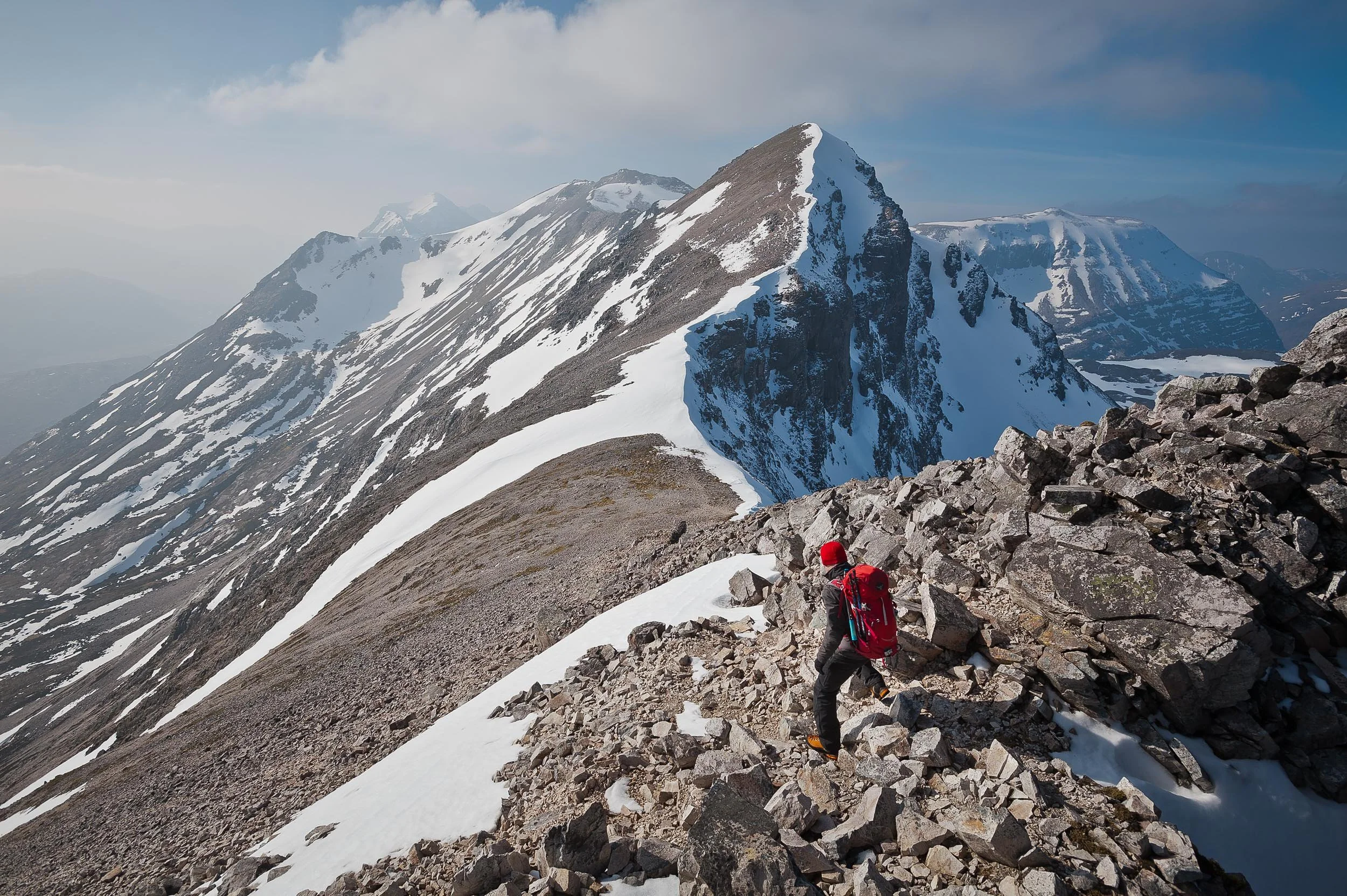
East to West on Beinn Eighe - A great ridge traverse in North-West Scotland
Photos from an East to West traverse of the peaks and ridges of the Beinn Eighe Massif in the North-West Highlands of Scotland.

This was my eighth ascent of Beinn Eighe, a mountain in the North-West Highlands of Scotland. It was my first time via the ‘Black Carls’ ridge of Sgurr nan Fhir Duibhe. The ascent of this 963m high peak is around winter grade I/II heading west, with the crux being a steep climb out of the prominent notch you can see on the rocky ridge on the picture below.
In 1951, Beinn Eighe was designated Britain's first National Nature Reserve. The NatureScot website details how the massif 'embraces a vast area of 48 square kilometres' between Loch Maree and Glen Torridon, 'stretching from loch-side to mountain top', with a 'huge cluster of rugged peaks, ridges and scree-covered slopes' in between.
For mountain walking, Beinn Eighe is a dream hill. It has 9 summits, two of which are Munros (Scottish mountains over 914.4m high), and it is home to arguably the UK's most majestic mountain corrie, Coire Mhic Fhearchair, with its deep loch and 300m high cliffs that form the Triple Buttress. The mountain also forms part of the 42km long running route for the Celtman Extreme Scottish Triathlon.
We started our day near Kinlochewe, in beautiful Spring weather, ascending a scenic track and then snow to reach the summit of the most easterly peak on the Beinn Eighe massif, Creag Dubh. From there, we headed west, following the most amazing ridgeline, 5km+ long, that took us over the Black Carls, Sgurr nan Fhir Duibhe, Sgurr Ban, Spidean Coire nan Clach, Coinneach Mhor and Ruadh-stac Mor before we descended steep ground into Coire Mhic Fhearchair and headed for home.
My only regrets are we chose to miss out Sail Mhor, which would have maximised the aesthetic but been a 3km round trip, and we skipped the descent of the scree gully into Coire Mhic Fhearchair due to bullet hard ice at the entrance, choosing instead for safety reasons the steeper descent of the western slopes on Ruadh-stac Mor - which, whilst not difficult, proved to provide a couple of awkward moments due to the late season snow.


Weekend Wonder - Corrour Bothy
Walking and staying overnight in a mountain bothy in Cairngorms National Park, Scotland.

Corrour bothy beneath Devil’s Point in Cairngorms National Park
Bothies are unlocked shelters dotted about the UK, many of them managed on limited funds by the Mountain Bothies Association (MBA). Often remote, bothies vary in quality and, if you're like me, your feelings towards them can change depending on how tired you are or how bad the weather is outside. (Even a really basic bothy can be a delight when the weather is foul).
Corrour bothy, located in the Cairngorms National Park, is one of the more popular Scottish bothies. It’s not far from my home and I’ve made multiple trips there over the years.
The range of feelings I’ve experienced at Corrour bothy includes;
Enlightenment - through long, varied conversations with like-minded souls I otherwise wouldn’t have met
Happiness - to live in a country where I can freely wander up hills and through glens and stay out overnight
Annoyance - to find lots of garbage left behind by previous parties (there's no rubbish collection service in mountain bothies)
Satisfaction - as I sat outside with a dram on a beautiful Summer's evening after a trek over the Lairig Ghru
Relief - to reach the shelter of the bothy in the midst of a full Winter storm
Overall, my main feeling towards mountain bothies is one of contentment. From knowing that bothies exist and I can stop for a break from the outdoors if I want to, as on this day one Autumn when I walked door to door from the National Trust base camp at Mar Lodge over Devil's Point, Cairn Toul, Sgor an Lochain Uaine and Braeraich, four of the great Munros in Cairngorms National Park, during a fantastic hike that took me over 16 hours.
How to get to Corrour bothy
The Mountain Bothy Association publishes details of bothies on their website (www.mountainbothies.org.uk). You'll find Corrour bothy at GR NN981958 on OS Landranger map 36. It can be accessed from the south-east from Braemar via Glen Lui or from Aviemore in the north via the Lairig Gru.
Other bothies to visit
Less well known bothies worth a visit include Glencoul and Glendhu bothy near Kylesku, the Schoolhouse bothy near the Munro Seana Braigh and the fantastically-positioned Lookout bothy on the northern tip of the Isle of Skye, at Rubha Huinish.
If you do visit bothies, be aware of the bothy code;
Respect other users
Respect the bothy
Respect the surroundings
Respect the agreement with the estate
Respect the restriction on numbers
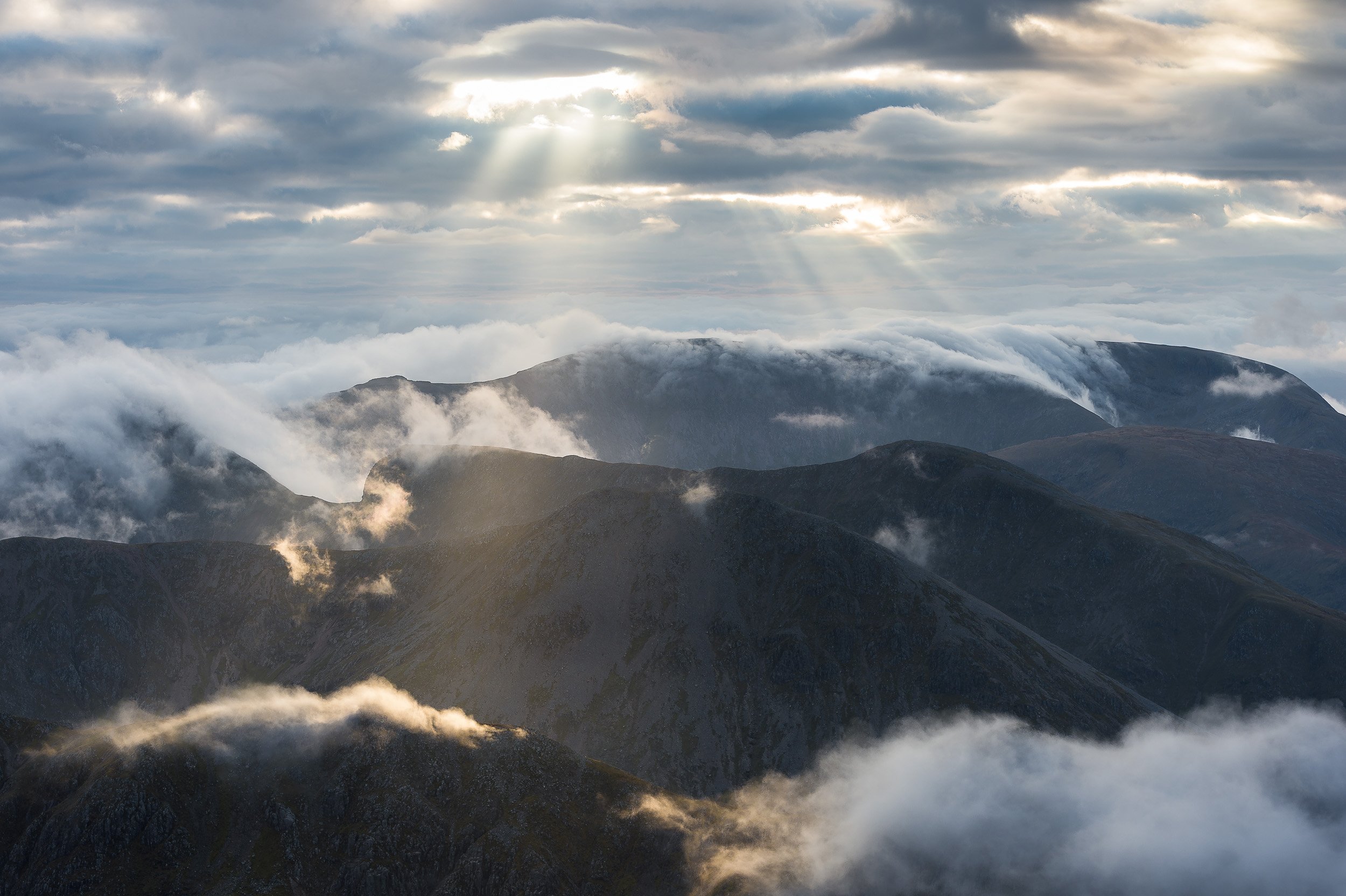
Viewpoint — Glen Coe summit camp
A feature in Outdoor Photography magazine about a wild camp on the rocky summit of Stob Coire nan Lochan above Glen Coe in Scotland.

Each year, in Summer, I like to take a few weeks out of Scotland’s mountains to let the temperature cool down and remove myself from the scourge that is the Scottish midge. By the time the cooler months of September and October arrive, I’m looking forward to ending my self-imposed exile and heading back into the hills.
My goal for this occasion was to sleep atop a mountain peak, photograph the sunrise for a personal client and scope out a location for a mountain running photo shoot I had pencilled in for later in the year. The internet is such a valuable resource these days for a landscape photographer and there’s many useful tools that will aid your planning (such as Google Maps, Google Images, Fatmap or the Sunseeker or Photographer’s Ephemeris mobile apps). You can research in detail exactly which locations should be worth going to and when, with the huge advantage of knowing in advance where the light will fall. A great deal of work can be done at home or in the office and if you’ve planned correctly, it’s simply a case of waiting and hoping for a spell of good weather.
For this trip, I’d researched an ascent of Stob Coire nan Lochan, a 1115m high rocky summit above Glen Coe in the West Highlands of Scotland, part of the Bidean nam Bian massif. I’d worked in Glen Coe before and relished the idea of heading back. For good reason — the landscape is incredibly varied for such a small place.
Parking is available at the popular Pass of Glen Coe and, in the early evening, I trekked into Coire nan Lochan, enjoying the effort of my ascent as darkness fell. The ground was familiar as I’d been in the corrie before, on route to a popular winter climb called Dorsal Arete. Scrambling up the rocky flanks of Stob Coire nan Lochan by head-torch was interesting and good fun and I was welcomed on the summit by cool, dry air, carried on a slight breeze. Settling in to my warm bivvy, I listened to the sound of stags braying loudly in the glens below and soon fell asleep.
Early morning light
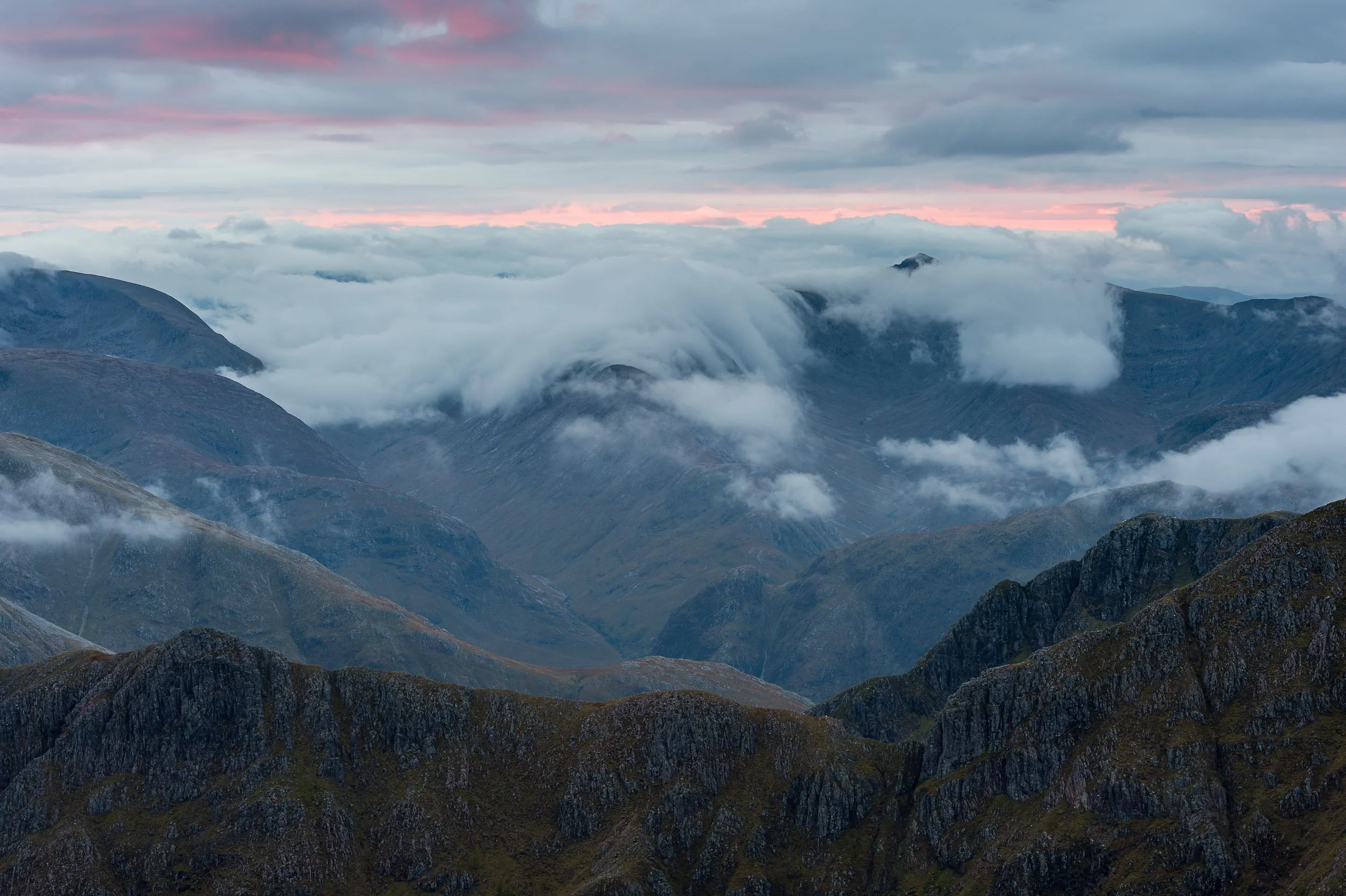
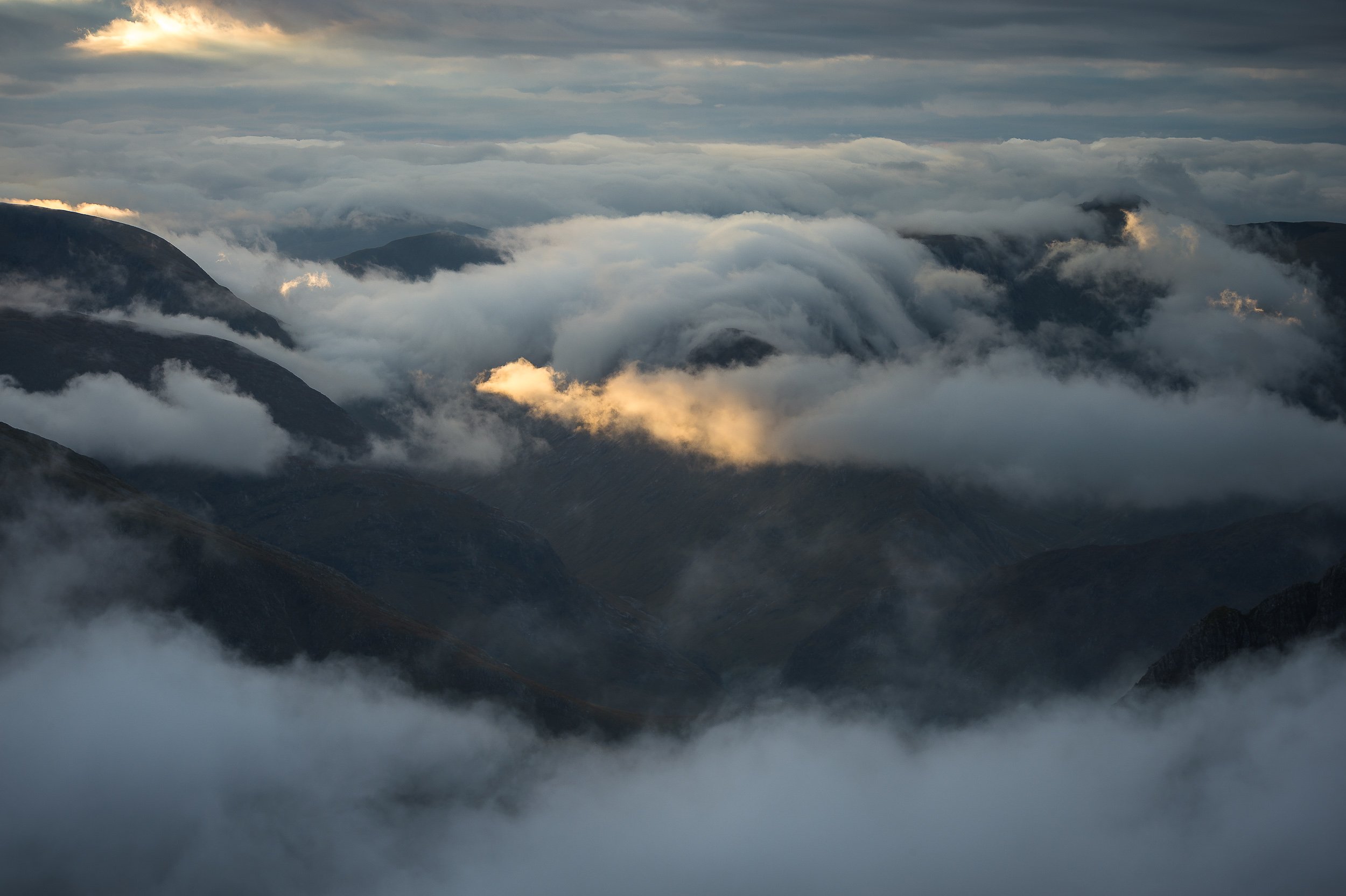
One of the benefits of photographing in Autumn is you don’t need to be up super early to catch the dawn. Sunrise was indicated as 7:37am and I was up at a very pleasant time of 7.00am. As I expected, I was on my own, with an uninterrupted 360-degree view of Scottish glens and mountains. Swinging my arms to warm up (I hadn’t brought a stove, to save weight), I set up my tripod, camera and wireless trigger in the gloomy light of pre-dawn, pre-visualised compositions I felt would be worthy to photograph and waited to see what would happen. Unfortunately, I wasn’t blessed with the most colourful sunrise but I was witness to some wonderful views as clouds formed in the glens beneath me and, as they rose they draped over the peaks, shafts of light piercing through the clouds and lighting up the landscape.
In all, I spent a very special few hours, in beautiful silence, switching between wide angle and telephoto lenses and shooting as many different compositions as I felt were worthwhile, lingering until dawn had truly broken, and the interesting light had gone. I then packed up and climbed to the summit of Bidean nam Bian (one of the 282 ‘Munros’, Scottish peaks over 3,000ft high), continuing along an easy ridge to a second Munro, Stob Coire Sgreamhach, before I retraced my steps to the head of the evocatively titled ‘Lost Valley’, and headed for home.



Viewpoint information
Distances in miles from nearest large town and nearest city
17 miles from Fort William
118 miles from Edinburgh
81 miles from Inverness
Access rating
5 — Mountain summit reached by some rock scrambling
How to get there
Travel the A82 road to reach the obvious main car park in Glen Coe. Depending on the time of day, this car park may be very busy and a bagpiper playing to the crowds — some smaller parking locations are nearby. Climb the path into Coire nan Lochan — one easy scrambling bit — then, when you each a prominent waterfall, head left on scree and scramble on slightly more difficult ground up the east ridge of Stob Coire nan Lochan to the summit. (A map and compass and the skills to use them is essential. Visit a dedicated walking resource, e.g. www.walkhighlands.co.uk, for more detailed instructions).
What to shoot
Wide angles of remote glens and mountain ridges with the A82 road, c.2,500ft beneath your feet. Switch to a telephoto zoom lens and pull out detail in the rocky cliffs beneath the summit of the nearby Munro, Bidean nam Bian (the highest point in Argyll). The infamous Aonach Eagach or ‘notched ridge’ is straight across the glen.
Best time of day
Any time of day for general photographs (expansive 360 degree views from summit). Best at dawn for the sun lighting up the glens and peaks to the east. Bivvying the evening before on Stob Coire nan Lochan is an option but the summit is very rocky and not altogether flat.
Nearest food/drink
Clachaig Inn, Glencoe, Argyll, PH49 4HX
W: www.clachaig.com
E: frontdesk@clachaig.com
T: +44 (0) 1855 811252
Nearest accommodation
Clachaig Inn, Glencoe — www.clachaig.com
Kingshouse Hotel — www.kingshousehotel.co.uk
Other times of year
Winter and Spring light in Glen Coe can be magical but mountaineering knowledge, skills and equipment are required to reach the summits when the ground is covered in snow and ice.
Ordnance Survey
OS Landranger map series 41 — Ben Nevis Fort William & Glen Coe
Nearby photography locations
Buachaille Etive Mor — 1 mile
Loch Etive (Glen Etive) — 17 miles
Lochan na h-Achlais (Rannoch Moor) — 11 miles

Kintail wanderings: 9 Munros north of Glen Shiel
A long day's walking over multiple Munros in Kintail in the North-West Highlands of Scotland.

Looking back to the summit of Sgurr Fhuaran, the last of day’s nine Munros north of Glen Shiel in Scotland
Recently, I was preparing a stripped down photography equipment list for occasions where I wanted to travel light outdoors but still needed to capture professional-quality images. Although the items of equipment I chose are lighter than my full bag of camera and lighting gear, they are still too heavy for me to carry on occasions when I’m not working and my goal is to push myself a little in the mountains.
My inspiration for challenging days out on the hills comes from the athletes I photograph as well as my friends. I’m nowhere near a mountain runner or fell runner but I’ve had plenty of photography shoots with professional runners (and follow their adventures online) and the ease and speed at which they travel over rough ground has made me realise that I enjoy moving quicker than walking speed in the mountains (something which I have attempted to do in the past with a full camera backpack but my lower back seeks to constantly remind me).
With this in mind, I purchased the lightest-weight camera I own, a Sony RX100 V for outdoor adventures for occasions where photography is not the focus of my trip but I still wish to capture decent-quality images. The images I’m able to produce with the Sony RX100 are on the borderline of what I’d class as being acceptable for professional purposes (I’m happy to use them for editorial submissions, social media posts and blogs) but the trade off when I’m not working is immeasurable. I can fit the camera into a stretchy front pocket of my backpack and easily fast-walk or jog with it up and down hills without any impairment on my activity, whilst still being able to document my day or take shots I can use later for e.g. location scouting purposes.
The type of outing I’d carry along a Sony RX100 on would be trail running in my local Pentland Hills, a multi-Munro route like the one described here, a hut-to-hut run in the European Alps or a long-distance mountain bike time trial, where my objective is to achieve a relatively big thing (for me) in a certain period of time and I don’t wish to be encumbered with a heavy pack.
An example of this was when I was looking for ideas for a challenging day out in Scotland. My focus was on Kintail in the North-West Highlands of Scotland. If I wished to climb a lot of Munros in a day, Kintail’s South Glen Shiel ridge allows for 7 summits to be ticked off in a fairly easy fashion. Opposite them on the north side of the glen, there are 7 Munros that I could do the following day (or perhaps even on the same day).
The record for the most amount of Munros in a day is held by English runner Kim Collison, who ran 100 miles and climbed 29,500ft to tick off a total of 33 summits in 23 hours and 59 minutes in 2021. The record for total Munro completions overall is Steven Fallon, who’s completed 15 rounds (of 282 hills, sometimes more) over a twenty year period. A qualified mountain guide, Steven is also an accomplished hill runner and his website has a number of running options if you’re looking to join groups of Munros together to make a longer day and set yourself a challenge.
I settled on Steven Fallon’s Kintail Sisters and Brother route, a 39km circular route with c.4000m ascent that includes two nearby Munros and takes in 9 Munro summits. The route starts and ends at the outdoor centre at Morvich and my goal was to complete the round in a certain timescale, using some adjustments I prefer to Naesmith’s formula (which I calculate at 4km/h for every km travelled and 1 hour for every 600m ascent). This isn’t running pace but to achieve it means not stopping so I figured it was a good enough challenge and it would provide me with a day out that would test me but not break my legs (figuratively speaking, not literally). In the end, I didn’t quite manage to complete the route in Naesmith’s timings (it took me 16 hours instead of 15) but I still felt in great shape at the end and it was a memorable day out.
Glen Shiel Sisters and Brothers route (including two additional Munros)
Distance: 39km / 24 miles
Ascent: 4105m / 13,467ft
Time: 16 hours 03 minutes
(Steven’s website recorded this route as 35km / 22 miles in distance with 3,140m / 10,300ft ascent but my calculations were as above, which I corroborated with a friend and then Steven afterwards).
Munros climbed
A'Ghlas Bheinn (918m)
Beinn Fhada (1032m)
Ciste Dhubh (979m)
Aonach Meadhoin (1001m)
Sgurr a'Bhealaich Dheirg (1036m)
Saileag (956m)
Sgurr na Ciste Duibhe (1027m)
Sgurr na Carnach (1002m)
Sgurr Fhuaran (1067m)


Postscript
One of the reasons I wanted to attempt Steven’s Kintail route was because I have an itch to attempt Philip Tranter’s Round and the time I took in Glen Shiel would give me an indication if that was feasible. It’s relatively tight, with an additional 5 miles and 8,000ft I’d need to cover in the remaining 8 hours (which sounds straightforward enough but at my pace, which will no doubt be slowing by then, it only gives me one hour to play with).

Trail and hill running routes: Edinburgh’s Pentland Hills
A selection of trail and hill running routes, plus photographs, for Pentland Hills Regional Park near Edinburgh in Scotland.
A selection of routes in the hills near Edinburgh that I’ve enjoyed for trail or hill running. They’re perfectly good ideas for walking trips too.
Update July 2025 - I no longer live in Edinburgh so unfortunately there won’t be any new routes added.

A panorama of Turnhouse Hill, Carnethy, Scald Law, South Black Hill, East and West Kip from Castlelaw Hill. (View larger). See more Pentlands photos at the foot of this page.
The Pentland Hills in Scotland are a collection of small hills above Edinburgh in the north and Penicuik in the south. Generally around 500m in altitude (the highest peak is Scald Law at 579m high), they’re not overly big but there’s commonly c.100m ascent and descent between their summits, providing ideal opportunities if you’re wanting to keep hill fit or if you’re training for Scotland’s bigger hills.
Despite being born in Edinburgh, having stayed in the city all my life and generally always been keen on outdoor activity, I’d spent only a tiny amount of time in the Pentlands prior to the Coronavirus pandemic in 2020/21. My preference was to sit indoors on a Wattbike for local exercise and venture further afield to the Scottish Highlands for my hiking, mountain biking and trail running activities. During the Coronavirus-induced lockdowns, and continuing thereafter, that changed and I’ve visited Pentland Hills Regional Park often, on occasion 2–3 times a week, usually later in the evening or after dark, when it’s nice and quiet and very peaceful. (My past lack of interest doesn’t apply to the rest of Edinburgh and the peaks get fairly busy at popular times).
Listed below is a variety of trail and hill running (aka walking / jogging) routes I like to repeat in the Pentlands. For detailed route planning plus navigation, I’d recommend Pentlands Superwalker XT25 or Pentlands Ultramap XT40 maps from Harvey Maps. If you use Strava, the summitbag.com plugin by Phil Bellamy tracks the hills you’ve climbed and totals up your ascent over time.
Entry points to the Pentland Hills
Click the below to expand and view route choices.
-
Getting there - Follow the A702 road south of Edinburgh to Flotterstone Inn. Turn right and drive past the inn to the car park. (Google Maps). The 101/ 102 Edinburgh to Dumfries bus from Houston Coaches stops opposite the inn.
Walking / running routes -
Flotterstone to Turnhouse, Carnethy, Scald Law, South Black Hill, East and West Kip before descending to the drove road past West Kip and then return — c.15km and 1200m ascent (View on Strava)
Flotterstone to the bealach before Scald Law, traversing down to Green Cleugh via the tree plantation, then up and along the side of Black Hill and over Bell’s Hill before descending Maiden’s Cleugh to reach Glencorse reservoir — c.14km and 750m ascent
Alternative - As above over Bell’s Hill but at the top of Maiden’s Cleugh head NW instead towards Harlaw on a good track. Go through a gate and then head immediately NNW to reach the road just E of Wester Kinleith (there’s a path through the woods alongside the track). Head NE on the road towards Middle Kinleith and look for the sign for Poet’s Glen. Descend that to Blinkbonny and onwards to A70 Lanark Road to finish — 15.5km and 660m ascent (View on Strava)
Flotterstone to Carnethy then continue onto the bealach before Scald Law and descend via the tree plantation to Green Cleugh. Head up the steep slopes of Black Hill (after the Pinnacle and opposite the waterfall) then descend NE from Black Hill summit to reach the bealach before Bell’s Hill. Follow the track SE to Glencorse reservoir and then take either the road back to the start or, not far past Glen Cottage, cross through a wall onto a track that goes to the filter beds and return via the start of the Scald Law route — 13km and 730m ascent
Flotterstone first to Castlelaw and then over to Allermuir. Head W to Capelaw and climb Harbour Hill and Bell’s Hill before climbing the long SW flank of Black Hill. Descend the long track from Black Hill summit to the road by Logan Burn and return to Flotterstone — 16.5km and 900m ascent (View on Strava)
-
Getting there - Follow Colinton Road out of Edinburgh city centre. Just before Colinton village, head left, following the signs for Pentland Hills Regional Park, then go uphill past Bonaly Shop to the car park at the end of the road. (Google Maps). Public transport-wise, the number 10 bus from Lothian Buses takes you closest, opposite Bonaly Shop.
Walking / running routes -
From Bonaly Tower ascend Scaletrix to Bonaly Reservoir. Climb Capelaw Hill and Castlelaw before descending to Glencorse and returning to Bonaly via Maiden’s Cleugh and Harbour Hill (or sometimes just Phantom’s Cleugh) — c.15km and 620m ascent
Repeat the above up until Maiden’s Cleugh but then descend first NW and then NNW to Kinleith buildings and then return to Bonaly via Clubbiedean and Torduff reservoirs — c.17km and 510m ascent
From Bonaly car park choose either Scalextrix or the track directly uphill through the woods to reach Bonaly reservoir. Ascend Capelaw Hill then Allermuir and Caerketton. From Caerketton’s summit, head shortly E to join a track that traverses SSE then SSW around Caerketton’s southern slopes, past Boghall Farm and the Tytler Memorial Cross, to reach Castlelaw car park. Decend from the car park to Glencorse reservoir and then ascend Maiden’s Cleugh for the return to Bonaly — c.18.5km and 790m ascent (View on Strava)
From Bonaly shops, head past the Scout Centre to the second car park. Continue uphill towards Bonaly reservoir but take the first right and then left S of Torduff and ascend through the woods to reach the foot of Scaletrix. Continue up Scaletrix and turn right through the gate and onwards to ascend Harbour Hill. From the summit, continue SE on a very runnable grassy track to reach Glencorse reservoir. Touch the gate and then turn around and take the track NW up Maiden’s Cleugh. At the next gate, either ascend Harbour Hill again for a return to Bonaly or continue NW and then W into Balerno or NW and then N to Wester Kinleith and into Currie, the latter recommended via Poet’s Glen — c.11.5km and 400m ascent (View on Strava)
As above to Harbour Hill but continue SE and then SW to the top of Maiden's Cleugh. Continue SE on often wet ground to climb Bell's Hill and then descend first NW then SW on steep, grassy ground (which can slippy lower down, when wet). Don't ascend Black Hill but take the track SE towards Glencorse reservoir. Follow the road around, past the farm and the first gate (which leads up Maiden's Cleugh). Continue along the road with the reservoir on your right and a walled field on your left until you reach a wooded area on your left. Go through the small second gate at these woods and ascend to reach a second gate. Turn right for 50 yards and then ascend steeply NE up the SW slopes of Castlelaw. Descend towards Allermuir but trend left to the reach foot of Capelaw Hill. Climb this and then continue SW and then N to return to Bonaly — c.13.5km and 630m ascent (View on Strava)
-
Getting there - Take the Lanark Road out of Edinburgh to Balerno and follow the signs to Threipmuir reservoir. (Google Maps). The 44 bus terminus for Lothian Buses is not far down the road.
Walking / running routes -
Balerno bus terminus to Threipmuir then up the Red Road to West Kip, East Kip, South Black Hill and Scald Law. Descend NW from the bealach before Carnethy to Green Cleugh (either direct to the Howe or via the tree plantation) then traverse along the side of Black Hill, continue over Bell’s Hill and Harbour Hill and descend Scaletrix to finish at Torduff reservoir / Bonaly — c.20km and 860m
Alternative (1) - Head back to Threipmuir after traversing the side of Black Hill — c.12km and 470m ascent
Alternative (2) - Descend instead from East Kip down to Green Cleugh and head back to Threipmuir via Bavelaw Castle — c.10km and 450m ascent
Alternative (3) - At Black Springs, cross over at the dam to the N side of the reservoir and return E to Threipmuir car park — c.14km and 920m ascent (View on Strava)
Follow the main route above to West Kip but head SW instead over Greenlaw and Spittal Hill to North Esk Reservoir. Follow the track to Bore Stane then descend N to Kings Hill then NE over the ‘Yellow Brick Road’ track to Western Bavelaw — c.19km and 600m ascent
Follow the ‘Yellow Brick Road’ from Wester Bavelaw farm to Bore Stane. Ascend East Cairn Hill, West Cairn Hill and Byrehope Mount. Descend to Baddinsgill Farm then climb Mount Maw, Grain Head and The Mount. Descend to North Esk reservoir and head back to Bore Stane and Threipmuir by your outward route — c.34km and 1240m ascent
Alternative - Take the ‘Yellow Brick Road’ to Bore Stane as above. Descend SSE on a fun trail to reach North Esk Reservoir. Climb from the water and continue over Spittal Hill and Green Law towards West Kip. Descend the drove road (aka ‘Red Road’ to Balerno) — c.20km and 635m ascent (View on Strava)
From Threipmuir car park, continue past Threipmur and Harlaw reservoirs to cross the dam at Black Springs. Traverse the NE slopes of Black Hill to reach Bell’s Hill. Don’t ascend Bell’s Hill but continue on the obvious track SSE towards Logan cottage (considering a not-so-visible shortcut over the lower slopes of Gask Hill) to reach the road at Logan Burn. Climb steeply up the N ridge of Carnethy before finishing at Hillend via Turnhouse, Castlelaw and Allermuir — c.17.5km and 820m ascent (View on Strava)
From Balerno bus terminus, head to Wester Bavelaw via Threipmuir and Balerno Common. Take the ‘Yellow Brick Road’ to Bore Stane and then continue SSE to North-Esk Reservoir and an ascent of Patie’s Hill. Descend to Nine Mile Burn then head to West Kip either via Cap Law or the track on its E side, returning to Balerno via the Red Road — c.25km and 705m ascent (View on Strava)
-
Getting there - Continue past Hillend on the A702 Biggar Road to Castlelaw Hill Fort Car Park (Google Maps). The 101 / 102 Houston Coaches bus to Dumfries may stop on the main road on request. The car park can also be reached on foot from Hillend.
Walking / running routes -
Head in a SE direction from the car park to the road from Flotterstone to Glen Cottage and continue SE down to the start of the route for Scald Law. Climb Turnhouse and Carnethy then continue onto the bealach before Scald Law and descend via the tree plantation to Green Cleugh. Traverse the lower slopes of Black Hill, climb Bell’s Hill over to Harbour Hill and Capelaw and descend back to Castlelaw car park — c.17.8km and 1180m ascent (View Strava)
-
Getting there - Follow the A702 Biggar Road out of Edinburgh. Just past Steading public house, turn right for Midlothian Snow Sports Centre. (Google Maps). Alternatively, a few hundred metres short of the pub follow a track W alongside the golf course to Swanston village. Lothian Buses 4 and 11 take you closest on public transport, near Fairmilehead.
Walking / running routes -
From either Hillend or Swanston, climb direct to Allermuir and continue over Capelaw Hill and Harbour Hill to Maiden’s Cleugh. Head SE on the track to Glencorse Reservoir then climb Castlelaw and Fala Knowe and return over Allermuir back to the start — c.13.5km and 790m ascent (View on Strava)
Ascend Caerketton and Allermuir, continuing over Capelaw, Harbour Hill and Bell’s Hill before heading SE on the track towards Glencorse. Continue along the road towards Loganlea reservoir and then head up the N ridge of Carnethy, returning to Hillend via Turnhouse, Castlelaw and Allermuir — c.24.5km and 1575m ascent
Alternative (1) - As above to Allermuir but, instead of heading up Capelaw, descend SW on a grassy trod to Phantom’s Cleugh to join the track down to Glencorse Reservoir — c.17km and 1230m ascent
Alternative (2) - From Glencorse, follow the road around the reservoir towards Flotterstone but, just before the first set of woods on your left, go through the gate and head towards the foot of the SW ridge of Castlelaw. Ascend here direct, steeply at first but with gradually extending views, returning to Hillend via Fala Knowe and Allermuir. — c.13.5km and 800m ascent
Climb Caerketton and Allermuir then descend Phantom's Cleugh to Glencorse and follow the road alongside Logan Burn. In between Logan Cottage and Logan House, head NW through the fence and continue W up a track towards Black Hill. From the summit, descend SW towards Balerno but then turn NNE and traverse Black Hill, heading towards Bell's Hill. Summit Bell's Hill (or traverse it instead) and then ascend Harbour Hill, descending that to reach Bonaly Reservoir. Either finish here via Bonaly or climb Capelaw and Allermuir and return to Fairmilehead via Swanston village — c.23km and 1215m ascent (View on Strava)
Alternative - As above but ascend Capelaw, Harbour Hill and Bell’s Hill before reaching the road at Logan Burn SW of Glencorse reservoir. From Black Hill summit, continue SW into Green Cleugh and head out via Balerno — 20km and 1015m ascent (View on Strava)
Castlelaw twice - From Hillend, climb Caerketton and Allermuir before continuing over to Castlelaw. Descend the steep and loose SE flank and once on the trck, continue to CastleLaw Hill Fort car park, head first S and then W and NW to climb the equally steep SW slopes of Castlelaw. After your second time at the Castlelaw summit, return to Hillend via your outward route (or descend N from Allermuir and descend instead to Swanston) — 15.5km and 880m ascent (View on Strava)
Pentland skyline — Caerketton, Allermuir, Castlelaw, Turnhouse, Carnethy, Scald Law, South Black Hill, East Kip, West Kip, Hare Hill, Black Hill, Bell’s Hill, Harbour Hill, Capelaw, Allermuir, Caerketton — c.32km and 2100m ascent (View on Strava)
Alternative - From West Kip, descend the Red Road to Threipmuir and onto Balerno — c.22.5km and 1400m ascent (View on Strava)
-
Getting there - Take the A702 from Edinburgh past Penicuik and Silverburn. (Google Maps). The 101/102 bus Houston Coaches stops on request.
Walking / running routes -
From Nine Mile Burn, head NNE, traversing Braid Law to reach the road leading to Westside Farm. Continue straight ahead, with South Black Hill and Scald Law on your left, and continue all the way past Carnethy. Climb heather to reach the track just E of Carnethy summit and return to Nine Mile Burn over the tops (heading for Cap Law from West Kip) — c.15.5km and 865m ascent (View on Strava)
-
Getting there - Take the A702 from Edinburgh past Penicuik, Silverburn and Nine Mile Burn. (Google Maps). The 101/102 bus Houston Coaches stops in the main street.
Walking / running routes -
A horseshoe route from Baddinsgill taking in West Water reservoir, King Seat, Byrehope Mount and West Cairn Hill on the west side and East Cairn Hill, Wether Law, The Mount, Grain Heads and Mount Maw on the east, with Cauldstane Slap in between — c.22km and 870m ascent (View on Strava)
As above but from East Cairn Hill trend E to Bore Stane. Cross Kitchen Moss, initially E and then NE, and then either descend before Hare Hill to Balerno — 25km and 730m ascent (View on Strava) — or continue over Hare Hill and traverse the side of Black Hill, go over Bell’s Hill and traverse the side of Harbour Hill, descending the Scaletrix route to Bonaly — c.29km and 1100m ascent
West Linton to Hillend - As above but instead of heading back to West Linton, head NE towards North Esk Reservoir from The Mount and onwards over Spittal Hill and Green Law. Continue over West Kip and the southern Pentland skyline to Turnhouse. Descend here to Flotterstone and then choose one of two ways over Castlelaw to reach Allermuir and down to Hillend — 40km and 2295m ascent (View on Strava)
West Linton to Carlops via the Roman Road and then up to North Esk Reservoir and continue over Spittal Hill and Green Law to West Kip — c.10km and 465m ascent. Various options from there back to Edinburgh.
Alternative (1) - As above but from North Esk Reservoir head NNW to Bore Stane and onwards to reach Threipmuir and Balerno.
Alternative (2) - West Linton towards Baddinsgill House via Stonypath then up onto Faw Mount and Mount Maw for a traverse of Grain Heads, The Mount and Wether Law to East Cairn Hill. Descend from there to Balerno via Bore Stane and the ‘Yellow Brick Road’ —c.18km and 685m ascent — or continue over Kitchen Moss to Hare Hill and around the side of Black Hill to descend to Bonaly via Harlaw — c.21km and 850m ascent
-
Getting there - Take the A702 towards Moffat. Park in Dolphinton (there’s no parking in Dunsyre) and follow the road to Little Sparta. (Google Maps). The 101/102 bus from Houston Coaches stops on the main road.
Walking / running routes -
Dunsyre to Hillend (a Pentland Hills marathon route) - Taking in Craigengar, West Cairn Hill, East Cairn Hill, Wether Law, The Mount, Spittal Hill, Greenlaw, West Kip, East Kip, South Black Hill, Scald Law, Carnethy, Turnhouse, Castlelaw, Allermuir and Caerketton — c.44km and 2000m ascent (View on Strava)
Dunsyre to Bonaly - As above to East Cairn Hill but descend to Bore Stane, cross Kitchen Moss to Hare Hill and traverse along the side of Black Hill. Climb Bell’s Hill, go around the side of Harbour Hill and finish in Bonaly via Scaletrix — c.37.5km and 1215m ascent (View on Strava)
The Pentland Way - Recognised as a long-distance walk from Dunsyre to Swanston, it’s also ideal for running — c.31.5km and 1150m ascent
Photo gallery
I periodically post stories on my Instagram account from my visits to the Pentlands. Follow along at www.instagram.com/colinhendersonphoto (see saved Stories > Local Hills).
All photos are captured with a Sony RX100 camera which I like to use when I’m not working, or an iPhone.


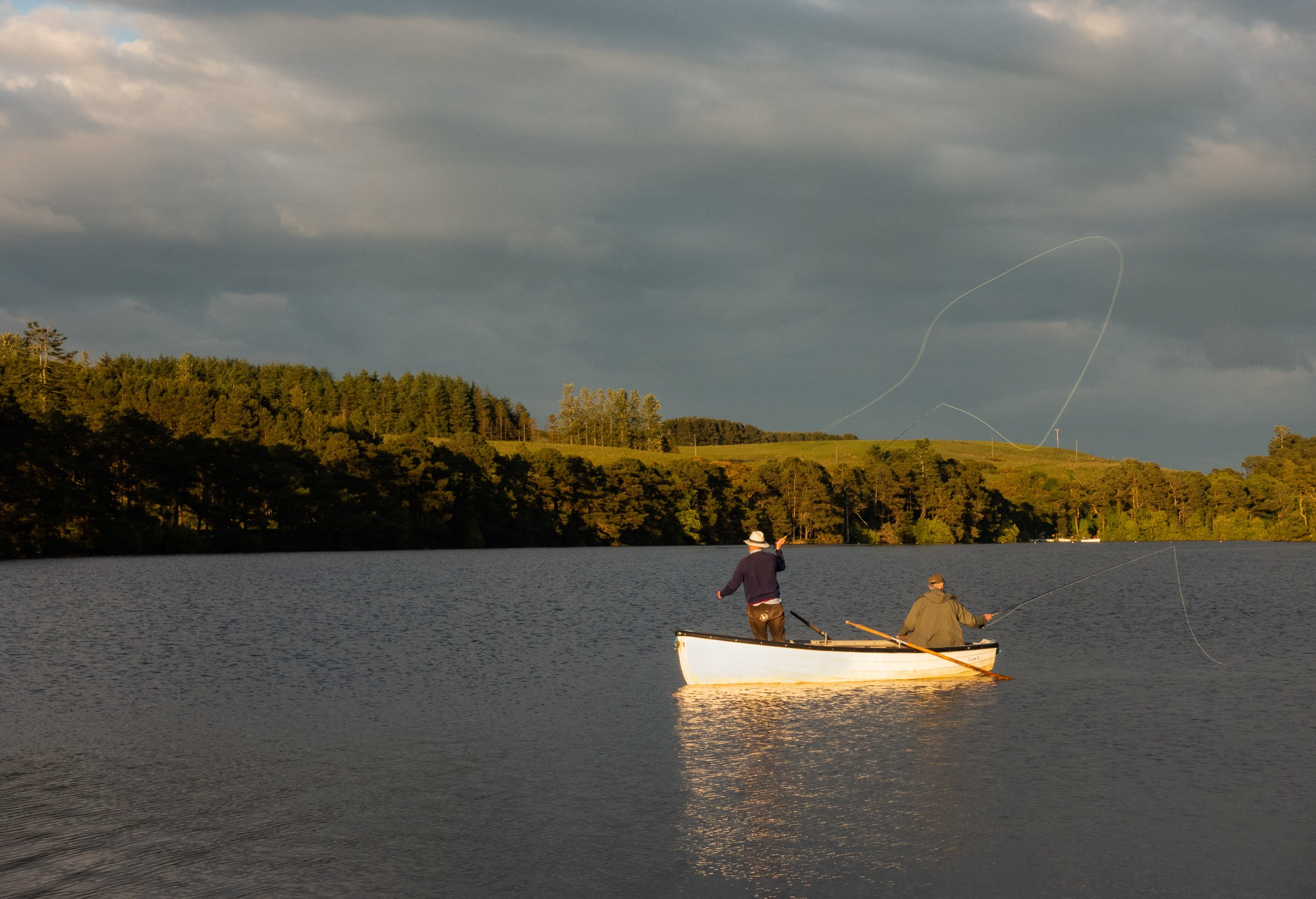


Cairngorms Loop — A 300km mountain bike time trial in Scotland
A successful finish of the challenging Cairngorms Loop, a 185-mile mountain bike time-trial in Cairngorms National Park, Scotland.
An account of my experience cycling 52 hours off-road on the 185-mile Cairngorms Loop.

On route to Bynack More, a Munro in Cairngorms National Park, Scotland. (The Cairngorms Loop ascends the path top-left).
It proved to be a mountain bike race of many firsts for me. The first time I’d cycled for more than 12 hours. The first time I’d hiked-a-bike for almost 14 consecutive kilometres. The first time I’d broken up 37 hours of continual effort with only 3 hours sleep. And, as I ascended the steep slopes of Culardoch, a 900m high Corbett near Braemar, c.200km into Scotland’s 300km Cairngorms Loop, the first time I’d fallen asleep whilst standing up, as I pushed my mountain bike up a hill. I recall blinking heavily as I’d stared into the darkness. It was 11pm on a Sunday night. I still had 15 hours to go before I was finished.
“You always want to run before you can walk” said my friend Davy, metaphorically speaking. Over lunch, I’d expressed interest in making a second attempt at the Cairngorms Loop, an unsupported 300km (185-mile) mountain bike time trial around the Cairngorms National Park in the Eastern Highlands of Scotland. My first attempt at this long-distance, off-road cycling route, which you’re challenged to finish within 56 hours, ended ignominiously in 2014 on a cold, wet and windy weekend. Constantly numb fingers and cold feet led me to bail not even halfway through. I suffered from pins and needles in my hands and feet for several months afterwards.
In the case of mountain biking, what Davy said about ‘running before I could walk’ was true. On paper, I was completely unqualified for something like the Cairngorms Loop. Other than my first attempt at the route, the only long-distance mountain biking I’d done previously was in a pair, with Davy, at the 2015 Strathpuffer, a 24-hour winter mountain bike endurance event in the North-West Highlands of Scotland (I’d also previously completed the ‘Puffer as a part of a team of four). Aside from that, I didn’t regularly bike, unless you count a daily 15-minute commute and 4-hours of indoor cycling every week at my local spinning studio. But I’d done a little mountain biking in our local hills and we’d fared okay at Strathpuffer (completing 20 laps and finishing in 18th position in the pairs category). Granted, a finish at Strathpuffer wasn’t much of an achievement for Davy — he’d previously competed in the solo category, on a single speed, and finished on the podium — but it cemented an idea for me that I could sit on a bike for a decent length of time and keep going. Coupled with my experience hiking and backpacking outdoors and a stubbornness I have to keep moving for long hours, summer or winter, I felt confident I could finish the Cairngorms Loop. I just wasn’t sure if I could do it in the 56-hour time limit. But as another friend said, “Well, there’s nothing to stop you from finding out”.
Guiding principle - Do it all yourself
The Cairngorms Loop is organised by Steve Wilkinson, a mountain biker from the north-east of England. Steve describes the Cairngorms Loop as an ‘independent time trial based on the classic Tour of the Cairngorms mountain bike route, using different trails to loop twice around the central Cairngorm Mountains with the intent being to ride the route as fast as you are able, whilst adhering to a set of rules for self-supported mountain biking’. There is ‘no entry fee or prize money’ and ‘there are no waymarkers or checkpoints and no support and you are expected to navigate the unmarked course entirely on your own, with no caches or pre-arranged support’. Steve also shares that ‘the inspiration for this challenge, and the self-supported philosophy based rule-set, came from North American events the Tour Divide, Colorado Trail Race, and Arizona Trail Race. The guiding principal being that you ‘do it all yourself’.
The Cairngorms Loop can be attempted at any time of year but a group ride is historically held at the end of April, when there’s still snow on Scotland’s hills, the temperature can drop to below zero degrees C and the threat of hypothermia is very real (the route ascends twice above 700m and crosses 11 rivers, at least one that can be thigh-deep, and if you’ve no spare clothes the only way to dry off is to keep moving).
On the clock
The start and finish of the Cairngorms Loop is the sleepy village of Blair Atholl in the southern limits of Cairngorms National Park. The idea is you leave Blair Atholl at 10am Saturday morning and you have to be back in Blair Atholl by 6pm on Monday. In between, you travel north through the Gaick Pass to Aviemore, over the shoulder of 1090m high Bynack More and the Lairig an Laiogh to Linn of Dee, back to Aviemore via Glen Feshie then east to Tomintoul, continuing over the shoulder of 900m high Culardoch to Braemar, then heading back to the Linn of Dee and down Glen Tilt. A sting in the tail being, as you approach Blair Atholl, the route crosses over to the remote outpost of Fealar Lodge and traverses the bulk of three Munros that make up the Beinn a’Ghlo massif before it leads you to the finish.
All the locations on the Cairngorms Loop had been burnt into my brain by the time I stood on the start line at the Old Bridge of Tilt car park in 2017. I’d felt a bit of a bikepacking fraud as I spoke to Steve and some of the the other competitors. My first attempt at the route had, it’s fair to say, been a bit Macgyver. I’d treated it as a backpacking expedition on a bike and I’d carried far too much of the wrong gear (enough to fill both the 40-litre rucksack and the panniers I carried with me, which included a tent) and not enough of the right (e.g. warm shoes and plenty of spare gloves). This year, despite a resolve to carry less stuff and the purchase of new bikepacking gear to put the weight on (my also new) bike, I still had a hillwalker’s mentality and had brought with me a fair amount of things that weren’t essential but that I *might* need (given it had been snowing at 600m above sea level three days previously). I clearly had more gear than others. But that was fine. My strategy for the race was to go slow and steady and to keep moving as long as possible. It’s a strategy that needs fuelled with a healthy amount of gear and food but the challenge for me in a race like this is invariably against myself, not the other competitors. A few extra kilos in weight wasn’t going to make or break my attempt.
How hard can it be?
-
Steve started us on the 2017 Cairngorms Loop with a simple two minute warning. We departed Blair Atholl and followed the old road alongside the A9 to the House of Bruar, I chatted to Donald McIntosh. who’d introduced himself as a software developer from Glasgow. Donald was competing in his first Cairngorms Loop (you can read Donald’s account here). I also caught up with Lucy Greenhill, from Oban, whom I knew from Oban Mountain Rescue Team. Lucy was also in her first race, using the experience as practice for her upcoming (and successful) attempt on the Highland Trail 550, the Cairngorms Loop’s ‘bigger brother/sister’. Lucy zoomed away from me very quickly (she went on to finish the Cairngorms Loop with a female FKT of 36 hours 42 minutes). It wasn’t long before Donald was also ahead of me as well and I was on my own and could settle into the challenge ahead.
The route through the Gaick Pass was as enjoyable as I remembered. Most of the route is on a good landrover track, the rivers we crossed were low and there was only a little hike-a-bike (across some marshy land to reach the singletrack alongside Loch an Duin). A good tailwind helped me leave the track behind and speed down the tarmac into Glen Trolmie, reaching a top speed of 48km/h as I’d drafted behind a car. I navigated the Thieves’ Road and crossed the woods on the great trails around Loch an Eilein into Glenmore Forest. By the time I reached Loch Morlich, I was an hour up on my 2014 time. I’d learnt from my first attempt at the Cairngorms Loop that 6 hours is the longest I can go on quick breaks and snack food before I get tired and grumpy so I stopped at the bridge at the foot of Bynack More for a 30 minute break and some energy food. I knew I’d appreciate the boost it would give me before the long climb to the Fords of Avon refuge and the hike-a-bike that I knew would follow as I crossed the Lairig an Laoigh into Glen Derry.
Donald McIntosh passed me again as I rested. I’d only moved in front of him because he’d taken a few wrong turnings and stopped for a cake and a Coca-Cola at Glenmore. I watched Donald as he cycled up the hill. He looked strong, much stronger than I felt. As I contemplated this, I was passed by another two competitors, who I presumed were racing together, as a couple. I don’t think I was in last position but I didn’t see either Donald or them (or anyone else) for the rest of the race. It was 4pm Saturday.
-
The climb over the shoulder of Bynack More across the Lairig an Laoigh to the Linn of Dee was never not enjoyable but it did test my patience. Numerous waterbars on the ascent plus a mixture of ground that was too technical for me to ride and numerous snow patches where I ground to a halt meant I pushed my laden bike for nearly 13 consecutive kilometres before I was able to get back in the saddle and speed up my descent into Glen Derry. I then misjudged a tree root in the dark and went over the handlebars. To add insult to injury, I soaked my feet and legs as I crossed the river to reach Derry Lodge.
My plan for the first 24 hours of the race had been to reach and bivvy in the woods in Glen Feshie (Ruigh Aiteachain bothy was closed in 2017 for renovation). However, the hike-a-bike across the Lairig an Laoigh had taken me some 6 hours and, with some time out for a late feast at Linn of Dee, it was 01:00am before I crossed the Moor of Feshie and started to follow the Geldie Burn. The Cairngorms Loop is not a navigational exercise — you follow an established .gpx route — but the light on my GPS only came on when I pressed it and I was mainly travelling by feel. Tiredness had kicked in and I made an error, mistaking the tributary river Allt Dhaidh Mor for the Geldie Burn itself. I followed a wet ATV track for 200m before I realised something wasn’t right. A quick check of the compass confirmed I was headed North and not West and I splashed my way back to the river. It was 01:37am and I’d been on the go for 15.5 hours. I decided it was time to stop and bivvy.
-
I awoke after a 4-hour sleep feeling fairly refreshed. For breakfast, I'd decided I'd eat snacks on the move (I did have a stove with me, to heat water for soup and hot chocolate, but I never used it). It does seem odd to want to graze on junk food at such an early hour but in the past I've been prone to not eating regularly when I'm on the hills (I'm reminded of a memorable Winter’s day on Beinn a’Ghlo when I hiked for 12 hours in deep snow and strong winds on some boiled sweets and a single slice of buttered malt loaf). These day, I generally go by the principle that any calories are good calories and I rarely, if ever, bonk. To that end, I'd prioritised Tailwind drinks powder and snack food that I knew from past experience I was happy to eat whilst exercising and I could consume easily whilst I was on the move. My breakfast consisted of chunks of Nak’d bars, M&Ms, liquorice torpedoes, a broken-up chocolate hazelnut bar, cheddar cheese cubes and Twiglets, all of which I ate periodically throughout the day as a handful of 'pot luck' out of a bar bag (though after my first taste of this savoury/sweet concoction I realised it was a bad idea to combine the Twiglets, which went soft in the cheese and didn't go with the liquorice. I usually like savoury and sweet foods together but you live and learn). Aside from these snacks, I also had with me a number of sachets of coconut-flavoured almond butter (Pip & Nut), a much healthier snack that I love but I found them to be tricky to open whilst on the move (I’ve not yet been able to replicate my childhood feats of riding my bike with no hands on the handlebars) and I wasn't fond of the taste when I swallowed the butter with fruit-flavoured water (which I needed to because it can be quite dry). A much better, healthier diet is something I'd want to focus on for future trips.
The nature of the terrain across the Moor of Feshie meant I was off my bike a lot through the morning as I crossed over towards Glen Feshie (I can't really remember why - I don't recall it being particularly rocky or wet). There are definitely worse places to push a bike but I do remember being glad when I crossed the river at Ruighe nan Leum and climbed the short slope to reach the landrover track that descended into Glen Feshie.
Glen Feshie is surely a contender for one of the loveliest glens in Scotland. The head of the glen has a really wild feel about it, with tall Scots pine trees adorning its steep sides, which are scarred by landslip, and a braided river that needs crossed twice. This river, the River Feshie, has the deepest water on the route and I got soaking wet feet and legs on both occasions (I almost swam for a bit on my second crossing but this was mainly due to my very poor route choice. I'm glad I didn't have to do it in the dark). The landslip at the head of the glen posed little problem, much less so than the much bigger landslip you encounter after the bothy - I found this really tricky terrain to haul a laden bike up - but I'd soon left the difficulties behind and I dried off as I raced past the car park at Auchlean, headed for Inverdruie.
-
The inner loop of the Cairngorms Loop crosses onto the outer loop near Feshiebridge. The point of no return though for the outer loop, I'd say, is at Inverdruie, near Coylumbridge, where you're closest to the 'fleshpots' of Aviemore. For no particular reason, I'd stopped at Inverdruie, opposite the adventure playground. As I sat on the ground and watched a family walk by, I felt frustrated and pondered whether I should jack the race in and get a train home. There wasn't any pressing need for me to do this as the weather was fair and I still felt quite strong but the sheer amount of pushing I'd done, regularly since 4pm the previous day, caused me to question my enthusiasm to continue. Fortunately, I'd picked up a fair amount of speed on the tarmac road from Auchlean to Inverdruie, and the route ahead continued for a bit on a paved road, so I gave myself a mental slap and started moving again before I changed my mind.
Once you're north-east of Aviemore, the Cairngorms Loop starts to head East towards Conie Hill and Forest Lodge. I got lost in this section on a couple of occasions but soon found my way back onto the route. I passed a man and woman on the bridge just after Forest Lodge as I entered the trails of Abernethy Forest. I went the wrong way here too before I found the almost hidden path that led me deeper into the forest onto some of the most delightful singletrack I've ridden, a gradual uphill through great greenery and beautiful Scots pine that brought me out to a superb view towards the direction of Bynack More.
I was in great spirits as I continued heading East and cycled past Loch a'Chnuic. I'd got over my funk at Inverdruie, I was enjoying the route again and my head was filled with grand thoughts about how I was going to reach Tomintoul much earlier than planned and how maybe I'd be able to finish on Sunday night. The trail through Abernethy Forest really had cheered me up no end. It appears though to have caused me to become somewhat irrational. As I'd stopped for a drink and admired the view, I turned the map over and realised I still had a whole page to cover before I reached Tomintoul. A whole page of a map that was encased in an Ortlieb map case. That's about 10 squares. 10km still to go. Just to reach Tomintoul. Which was 36km from Braemar. Which was 27km from Fealar Lodge. Which itself was still 30km from the finish. As this realisation sank it, it brought me back down to earth with a massive bump. I still had a huge distance to go. At the pace I was going, it really was going to be a difficult challenge to finish before Monday 6pm.
-
I’d laughed out loud when I truly realised how little concept I had of the distances the Cairngorms Loop covers. I’d thought about it, yes (I’d been thinking about it almost daily since December 2016) but, with no experience of long-distance mountain biking (if you discount lapping the 11km track at the Strathpuffer) I had nothing to properly compare it with. My mental model was so skewed it was laughable. As it turned out, this wasn’t so bad as it enabled me to put all thoughts about finishing the race on time out of my head. It was simply too far to get my head around. I resorted instead to something I’m good at. I concentrated on surveying my horizon and setting myself challenges. If I can get to x, I can get to y. If I can get to y, I can get to z. If I repeat that, I’ll eventually be where I need to be. It’s an approach I’ve honed over many years as I’ve hiked hundreds of kilometres across Scotland’s hills (including trekking most of the way from Fort William to Cape Wrath).
My change in mindset helped me to enjoy the rest of my journey to Tomintoul. I’m not usually a fan of the rolling, farmed land that is typical of the East of Scotland, preferring the rougher highlands to the North and West but it was nice to travel through parts of the country that I’d not usually visit. That’s not to say it wasn’t hard going. There were a couple of tough climbs and I went the wrong way just before Glen Brown and its multiple river crossings. But the countryside was scenic enough and my good mood had continued as I cycled into Tomintoul at 6.00pm on Sunday night.
-
I’d felt fairly fresh when I arrived in Tomintoul. Which was good, as I was cycling back to Blair Atholl, no matter what. The only question in my mind was how long would it take me. As I rode through Tomintoul’s main street, the thought of stopping for a hot meal in the hotel bar attracted my attention. I decided to keep going. My digestive system doesn’t take kindly to too much exercise after food — one of the reasons I decided to carry food for the whole route — but, more-so, I really wanted to finish within 56 hours and I still had no idea how long it would take me. The threat that I’d get to Blair Atholl after the cut-off and know I’d missed it because I’d stopped unneccesarily spurred me on. I put the thought out my head and got back to the task in hand.
There’s a distance of 36km between Tomintoul and Braemar and then a further 7 kilometres to reach Linn of Dee, where the River Dee threads its way through a narrow rock gorge. I wanted to reach Linn of Dee for two reasons — for the mental boost it would give me when I revisited ground I’d already covered (the outer loop joins the inner loop here for a bit) and because the distance home seemed much more manageable. All that barred my way was two long glens, a traverse along the shores of a remote mountain loch (Loch Builg) and a climb over a 900m high lump of a hill called Culardoch. Oh, and the fact I’d been on the move for 30+ hours.
After I’d left Tomintoul, I passed through the gates of the Glen Avon estate. Unfortunately, they were locked and they didn’t open grandly for me like a Lord entering his manor but a side door gave way to continued easy terrain — a landrover track that leads past the settlements at Torbain, Dalestie and Inchrory. A strong headwind built up as I made my way up Glen Avon towards Glen Builg. This kept my pace slow and continued to test my patience. I’d also began to suffer from pain in my right knee (which I still have as I type these words, 12 weeks later). My knee had ached slightly for a few weeks before the race but the terrain had aggravated it and by the time I’d reached Loch Builg and negotiated the 1km+ singletrack along its shoreline there was a fair amount of grimacing going on. I was glad when I reached the landrover track that took me to the foot of Culardoch. I started the steep climb. I think it was around 10.30pm. There wasn’t enough lack of light to warrant the use of my bike light but my head torch was on. I kept moving uphill, slowly. Pushing my bike in front of me and taking a few steps. Then pausing for a moment before repeating the process, over and over again. In a little pool of light, on my own, moving up the side of a hill at the pace of an ant. With each step, I complained to no-one in particular about the jabbing pain in my knee.
My climb in the dark up Culardoch felt like it went on forever. It definitely took longer than it should — I recall closing my eyes for a bit whilst I leant against my bike and I nodded off to sleep. If there was any consolation, it was that the hill track doesn’t go all the way to the summit — it climbs over a shoulder — and the pain of the ascent is soon a distant memory once you’ve encountered the amazing descent all the way to Invercauld Bridge.
I’d been considering stopping and having a sleep, first when I reached Invercauld (at the car park for Ben A’an and Beinn a’Bhuird) and again as I cycled into Braemar around 01:00am (I’d eyed up the tables outside the butchers opposite the outdoor shop). I decided I’d keep moving and I gradually ground my way along the road west of Braemar to reach the forest just short of Linn of Dee. At 02:30am, I rolled out my sleeping bag and bivvy bag in the forest, blew up my sleeping mat and I was asleep within minutes. I’d been on the go for 21 hours.
-
When I awoke a few hours later, the pain in my knee was sharp and I had difficulty bending it. I was concerned I wasn’t going to able to exit my sleeping bag, never mind cycle anywhere. After a fashion, I was on my feet and I found the pain eased off with movement and a few painkillers. As long as I bent my leg the way you’re supposed to and I didn’t move it too much laterally, I could cycle with relative ease.
It was a good feeling to rejoin the inner loop at the Linn of Dee, if only for a while. The route repeats a portion of the ground you’ve crossed earlier past White Bridge until you continue south over the Geldie Burn and the Bynack Burn and head into Glen Tilt. Despite my knee pain, I felt strong and the sleep had rejuvenated me. The sun was shining and I knew it was going to be a good day. Was I going to finish within the 56 hours? I still had no idea. But I was enjoying myself and all I had to do was to keep moving.
Glen Tilt is a popular Scottish glen for mountain biking. Recognition-wise, I’d suggest it’s on a par with Torridon in the North-West Highlands. The terrain as you cross the watershed into Glen Tilt is very scenic and the technical singletrack high up on the side of the glen is good fun, if a little unnerving at times due to the drop-off. Instead of descending the full length of the glen to Blair Atholl, the Cairngorms Loop crosses the waters of the Allt Garbh Buidhe far up and heads out to the remote Fealar Lodge. After the inclement weather we experienced in 2014, one competitor described to me how he felt very close to hypothermia at Fealar Lodge. He’d found it a very barren place, despite the farm, and was concerned about what little protection he’d had from the bad weather.
-
In 2017, the weather was warm and sunny and the river crossing to Fealar Lodge was easy enough. There was little flow in the water despite the snow that had fallen earlier in the week. On the opposite bank of the river, there is a steep ascent and a long traverse before you reach the lodge (I struggled to orientate myself here, despite having a map, possibly an indication I was more tired than I felt). Once you’ve circumnavigated the buildings at Fealar Lodge, there’s a fun, fast descent on a vehicle track that I’d been able to anticipate for a while from the other side of the glen. Unfortunately, the descent was over all too quickly and I had another push up a hill as I passed the Munro of Carn Righ on my left. Once I’d reached the bealach (which I recall had great views back towards the Cairngorms hills), I realised I wasn’t that many pedals away from the home straight. There’s a fantastically fast, flowing descent to the farmhouse at Daldhu. All that’s left is some fun singletrack up to the west side of Beinn a’Ghlo, another section of ‘this is going on forever’ hike-a-bike up to the bealach opposite Airgiod Bheinn and a great, grassy descent to the foot of Carn Liath before the final, easy river crossing and a glorious, glorious glide on tarmac downhill all the way into Blair Atholl.
And that was my finish to what proved to be a successful Cairngorms Loop for me in 2017. I’d tried in 2014 and failed. I’m sure I’d decided ‘never again’ but I’m glad I didn’t. There wasn’t any grand finish (though I’ll admit to raising my hands aloft, Tour de France-style, as I arrived through some grand gates into Blair Atholl) but I think this ties nicely into the nature of the event. There’s minimal rules. There’s no prizes. You get nothing other than your name on a website. It seemed fitting therefore that my arrival at the station was a muted affair. I was greeted quietly by a dog walker and two hikers, one of whom kindly captured the photographic evidence Steve asks you to capture to demonstrate you’ve completed the route within 56 hours (I arrived at 2.33pm on the Monday, with an overall time of 52 hours 19 minutes). Within a minute, the dog walker highlighted that the Edinburgh train was approaching the station and it was time for me to leave. The ice-cold can of Coca-Cola I’d been looking forward to for hours would have to wait. I boarded the train, secured my bike and grabbed a seat. (Annoyingly, I forgot to switch off my GPS so my top speed was recorded as 108km/h). As the train pulled out the station and the landscape raced by, I leant back and stared absent-mindedly out the window, enjoying the simple fact that there was no effort needed to move. I’d like to say I was thinking to myself “never again’ but, despite how hard the Cairngorms Loop was, I’d kind of enjoyed myself. Thoughts of how I could apply for the Highland Trail 550 Trail had already started to enter my mind.
Highs
Strong legs — One of the benefits of the many hours I spend each week indoor cycling
Strong head — At my level of experience, these types of long-distance time trials are as much, if not more so, of a mental challenge rather than physical. I’m pleased I kept going despite a few thoughts of bailing out
Deer — As I’d descended Culardoch into Invercauld Estate I surprised a herd of deer in the dark and cycled downhill as they ran beside me, just on the peripheral of my head-torch
Lows
Lot of hike-a-bike (for me) — An indication of my failure, not the course. I’d need to be a much stronger rider to be able to muscle my way over the more technical bits (and the snow, and the wet bits)
Body damage — I had pins and needles in my hands/feet for many weeks after the route (I’ll wear padded gloves next time) plus the small finger on one hand stuck out at a funny angle, which is a sign I believe to be damage to the ulnar nerve. I have Morton’s Neuroma in both feet and they significantly played up near Fealar Lodge and my right knee is still sore in August 2017, three months after.
Gear list
Worn (Continously)
Underwear, powerstretch tights, wool socks, hiking boots, neoprene overshoes; merino wool t-shirt (short-sleeve), synthetic t-shirt (long sleeve), pertex windshirt
On Bike (Bird Zero TR Hardtail)
Revelate Designs Harness + Salty Roll — Rab Winter Guide Jacket, pile mitts, spare pile mitts*, waterproof mitts*, waterproof hat*, spare base layer (top and bottoms)*, spare socks*
Alpkit Stingray frame bag — stove (MSR Pocket Rocket)*, pot* (MSR kettle) with 100g gas canister*, Fire Steel* and soup / chocolate sachets packed inside*), bike repair kit*, tools*, food (coconut almond butter sachets x6 and chocolate hazelnut bars x2), phone*, compass, bike lock*
Revelate Designs Vicacha seat pack — spare 27.5" inner tube (x2)*, sleeping bag (Rab Summit Alpine 400, rated to -4 degrees C) sleeping mat, bivvy bag, primaloft jacket (Rab Xenon Hoody)
Revelate Designs Mountain Feed Bag — chocolate m&ms, twiglets, licourice torpedoes, chocolate eclairs, cheese cubes, salted peanuts
On my back
Camelbak backpack (18l) — 3-litre hydration pack, neoprene gloves*, fleece top*, waterproofs*, Tailwind drinks powder
(*Item not used)
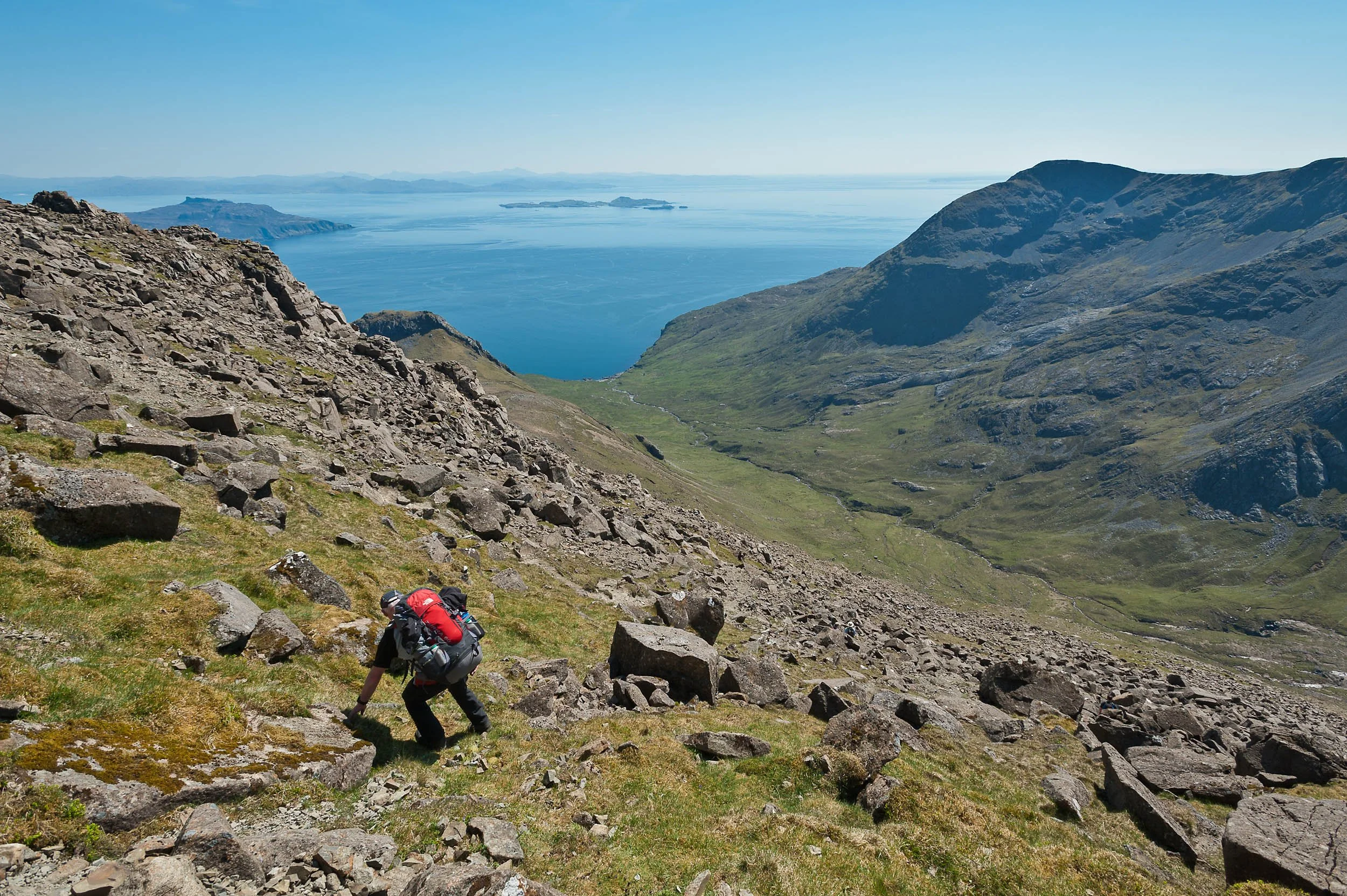
Weekend Wonder - Isle of Rum
Exploring the ‘other Cuillin’, on the Isle of Rum in the North-West Highlands of Scotland.

Bill Snee descending from Askival into Glen Dibidil on route to Dibidil Bothy on the Isle of Rum
The Isle of Rum is a National Nature Reserve and a Site of Special Scientific Interest (SSSI). There are no roads on the island and reaching it involves a boat trip, adding to the feeling of an adventure. The jewel of the island for walkers and climbers is the Rum Cuillin, which, like their counterpart, the Black Cuillin on the Isle of Skye, offers excellent rock scrambling along narrow ridges to mountain summits jutting above the Sea of the Hebrides, with great views out to the Atlantic Ocean.
The highlights of my visits to Rum have been hillwalking and backpacking trips on Ainshval and Askival, two of Rum's Corbetts. Although only c.2,500ft high, the view from both peaks is spectacular - a 360 degree view taking in Skye, Eigg, Muick, Canna, the Hebrides and much of Scotland's mainland west coast. On one occasion, on a sweltering bank holiday weekend in May, we bivvied on Ainshval's summit during an epic 3-day expedition where we climbed all Rum's hills, soaking in the heat and the views as the sun set as a fiery orange ball on the horizon. On another trip, pouring rain caused us to bail on a traverse of the Cuillin ridge into the Atlantic Corrie, a gigantic, amazing amphitheatre filled with seemingly no less giant stags that stood their ground and defiantly roared at us as we interrupted their rutting season.
Fortunately, my ratio of good days on the island outweighs the bad days. This includes the day we descended from Askival (pictured), after a brilliant Summer's day's hillwalking, which culminated in an engaging night making new friends at Dibidil bothy on the shoreline.
Getting there and around
Caledonian MacBrayne (www.calmac.co.uk) and Arisaig Marine (www.arisaig.co.uk) both offer easiest access to the island, via their ferry service. For venturing thereon in, you'll need to don your walking shoes. If heading anywhere remote, take standard hillwalking gear (e.g. warm clothes, waterproofs and gloves) plus be experienced in the use of a map (OS Landranger 39) and a compass.
Places to stay
The 'capital' of Rum, Kinloch, has an organised campsite plus cabins for hire. The Isle of Rum Community Trust operates a bunkhouse. Wild camping is an option all over the island (as long as you follow the Scottish Outdoor Access Code). Alternatively, choose to go basic and stay at one (or both) of the island's two mountain bothies - Dibidil bothy and Guirdil bothy). Read more about your options on the island's great website – www.isleofrum.com.

Weekend Wonder - Lochnagar’s mighty cliffs
An opportunity, perhaps. to see the Royal Family on Lochnagar, a Munro in Cairngorms National Park, Scotland.

Alex Haken backpacking along the top of the summit cliffs of Lochnagar,
Lochnagar, a 1155m high Munro in the Cairngorms National Park in Scotland, is a mountain with royal connections. The peak, located nearby Balmoral Castle, is the summer home of the Queen and the Queen's first son, Prince Charles, has been known to climb the hill when the family is in residence.
I had made two attempts to climb Lochnagar before this image was taken. Both times were in the depths of winter and on neither occasion did I meet another soul on the hill, royal or not. On my first attempt, I didn't get past the bealach beneath Meikle Pap, regularly unable to stand on two feet due to strong winds, and on my return I was thwarted at Cac Carn Mor, a giant cairn on the plateau at 1150m, just 5m shy of summit height but 0.5km away of the true summit, Cac Carn Beag. Not because it is slightly confusing (I believe a Mor is 'bigger' than a Beag so you would be forgiven for thinking it would be the summit) but again because of the weather. Great gusts of wind that had built speed over the surrounding rolling hills swept across the plateau and threatened to launch me off the top of Lochnagar's spectacular cliffs. These cliffs, some 200m high in places, hold lots of summer rock climbs and winter ice climbs. I don't believe they are appropriate for base jumping (even with a parachute) so, after a few calls that were too close for comfort, I half walked half crab-crawled my way back to the relative shelter of the approach path and returned with a friend in more amenable weather.
Getting there and around
Lochnagar is usually climbed as a day trip from the Spittal of Glenmuick. For added spice, head in from the North near Invercauld Bridge on the A93 Ballater to Braemar road and climb the great Stuic Buttress, a grade 1 scramble that takes you out onto the plateau near the summit of Carn ' Choire Bhoideach. From there, it's a simple 2km stroll across the plateau to Lochnagar. Alternatively, to enjoy the peak during an overnight trip, walk along the shores of Loch Muick and camp beneath the great cliffs near the Dubh Loch. You can tick off four Munros as you make your way back across the plateau to Cac Carn Beag and your fifth Munro of the day.

Weekend Wonder - Winter hiking on Streap
It’s not all about Munros. Winter hillwalking on a Corbett in the West Highlands of Scotland.

David Hetherington traverses a snowy ridge on Streap in the West Highlands of Scotland
My first sighting of Streap, a superb, 909m high Corbett in the West Highlands of Scotland, was on a 6-day backpacking adventure in 2010 from Glen Shiel to Glenfinnan, when a friend and I followed part of Scotland's epic Cape Wrath Trail. After I returned home, a paragraph in Ralph Storer's classic book, '100 Best Routes on Scottish Mountains', which highlighted Streap's narrow summit ridge "should be left well alone by the inexperienced" continued to intrigue me over the years.
In February 2016, I finally organised a visit to Streap. The weather forecast was excellent and we spent a great two nights in Gleann Dubh-Lighe bothy, trekking on snow-covered slopes through the day beneath a clear blue sky in temperatures that remained, pleasantly, well below freezing.
Ralph Storer was right. In poor weather, you'll need top-notch navigation skills to steer yourself through Streap's complex, craggy bluffs and its steep-sided, narrow arete demands caution all the way to the summit. On a nice day, the difficulties are slight and the ridge is simply awesome, with just the right amount of awkward terrain to keep your interest and incredible views - south-east to Ben Nevis and north-west out to the islands of Eigg, Rum and the Skye Cuillin.
Streap is an outstanding hill. We paired it up with an ascent of Streap Comhlaidh and another Corbett, Braigh nan Uamhachan, completing a round trip of ‘feet in front of the bothy fire’ to 'feet in front of the bothy fire’ of 12 hours (our slowness in part due to being hampered by deep snow). In Winter or Summer, you should find it's an excellent day out.
How to get there
Take a train, bus or car from Fort William to Glenfinnan. Roughly 3km south-east of Glenfinnan, just west of the bridge over the Dubh-Lighe river, a turn-off north leads uphill to a small public car park. From here, OS Landranger map 40 (Mallaig & Glenfinnan, Loch Shiel) and OS Explorer map 398 (Loch Morar & Mallaig) both cover the approach to Streap via the quiet highland glen, Gleann Dubh-Lighe.
Where to stay
Fort William and Corpach are obvious choices. Glenfinnan has a quirky bunkhouse - check out www.glenfinnanstationmuseum.co.uk. If you’re looking for more rustic accommodation, the bothy in Gleann Dubh-Lighe is maintained by the Mountain Bothy Association (www.mountainbothies.org.uk). In 2011, the building was accidentally burnt down when a leaky gas cartridge caught fire. In 2013, it was rebuilt by MBA volunteers.
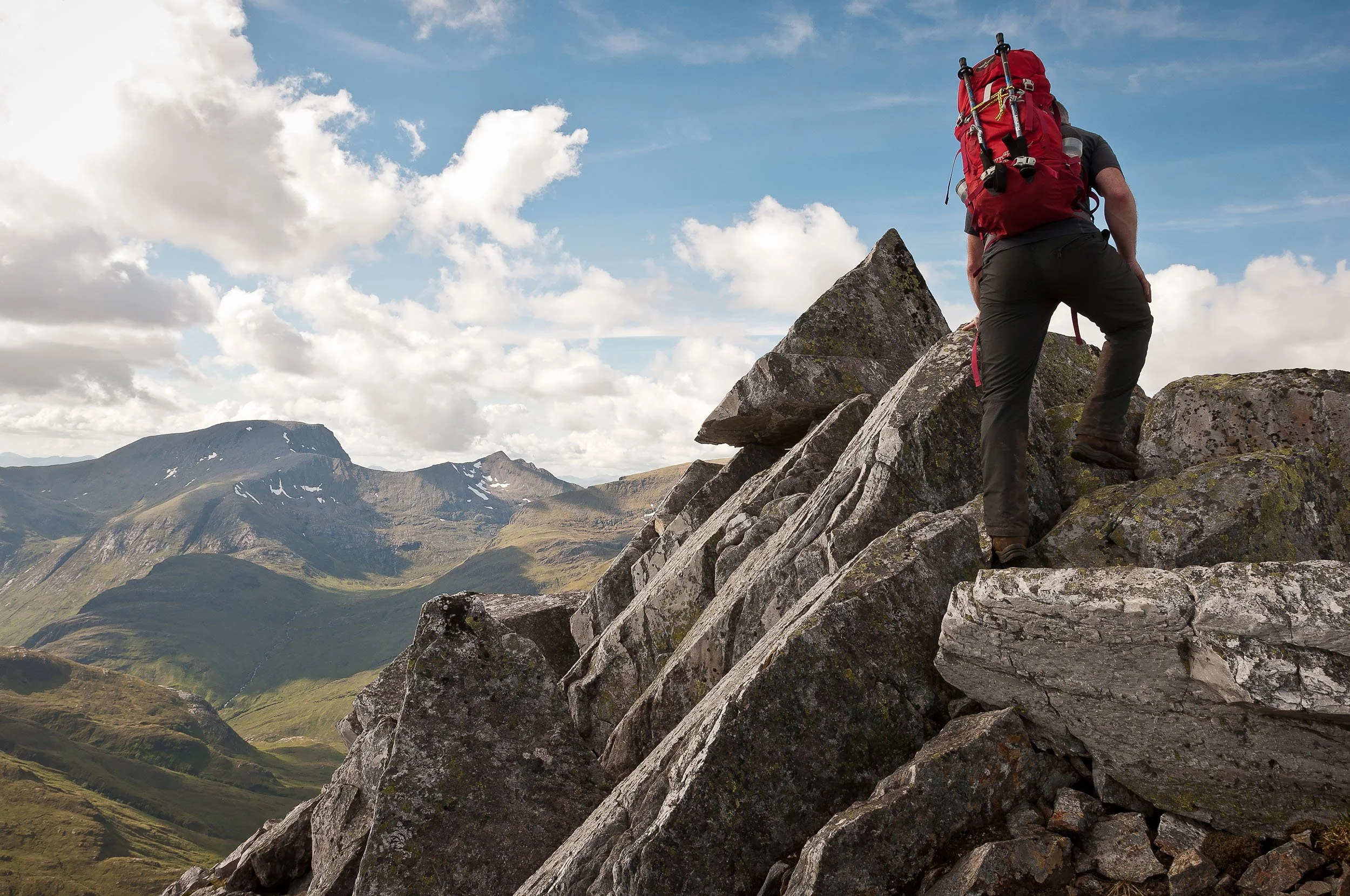
Weekend Wonder - Backpacking Tranter’s Round
A feature on walking and backpacking Tranter's Round in the West Highlands of Scotland.

David Hetherington on Binnein Mor in the Mamores, West Highlands of Scotland
A natural progression if you enjoy backpacking trips is to look for opportunities to link different routes together, increasing length and difficulty to set yourself a challenge. One such opportunity is Tranter's Round in the Lochaber region of Scotland.
Tranter's Round is named after Philip Tranter, son of the Scottish author, Nigel Tranter, who in 1964 devised a 24-hour challenge for fell runners when he connected (at the time) 19 Munros in the West Highlands of Scotland (the Mamores, Grey Corries, Aonach Mor and Aonach Beag, Carn Mor Dearg and Ben Nevis) in a 36-mile epic that covers 20,600ft of ascent. Tranter's Round is a fell runner's classic (superseded these days in terms of difficulty by a longer Charlie Ramsay Round, and with a demoted Munro) but it's a route that's also tailor made for backpacking.
To give us a head start on our attempt at backpacking Tranter's Round, we bivvied on a damp summit of Mullach nan Coirean in the Mamores at 2300 hours. Early the next morning, we continued over the Mamores, ticking off the peaks of Stob Ban, Sgurr a'Mhaim and Am Bodach. I didn't go out to An Gearanach, choosing to dry my sleeping bag in the sunshine instead, but Na Gruagaichean soon came next, then Binnein Mor, Binnean Beag and Sgurr Eilde Mor. Sixteen hours after we started out we descended and spent the night at Meanach bothy, having climbed 10 Munros.
Our return leg on day two is commonly called the Lochaber Traverse. First we ticked off the Grey Corries, starting with Stob Ban then Stob Choire Claurigh, Stob Coire nan Laoigh and Sgurr Choinnich Mor. A steep, grassy scramble then took us up onto a very wintry Aonach Beag. It was here that we decided to cut our trip short. A storm that had been distant for much of the afternoon brought in 50mph winds and freezing rain and, in true Scottish style, what had been a pleasant Summer's day turned distinctly nasty with a great risk of hypothermia. None of us are new to bad weather but with eight hours in, three Munros to do (including Britain's highest mountain) and a sharp scrambly ridge between them, it wasn't hard to make the decision to bail over Aonach Mor and descend to the roadside. Despite our disappointment, it was a great outdoor trip. Tranter's Round proved to be a very worthy backpacking route.
Travelling light
The current fastest known time for Tranter's Round, set on 01 June 2024, is 8 hours 27 minutes 53 seconds by Fort William-based GP, Finlay Wild. Although such a fast time will be unachievable (or undesirable) for most, adopting a hill running ethos for backpacking Tranter's Round isn't a bad idea. Travelling with as little gear as possible will be easier on your knees.
Navigation
Harvey Maps publish a map for the Charlie Ramsay Round, which includes the same peaks and is ideal for Tranter's Round. The route is also covered on Ordnance Survey Landranger map 41 (Ben Nevis, including Fort William & Glen Coe). You can choose to go clockwise or anti-clockwise. The latter has the distinction of finishing on Britain's highest mountain.