
Blog
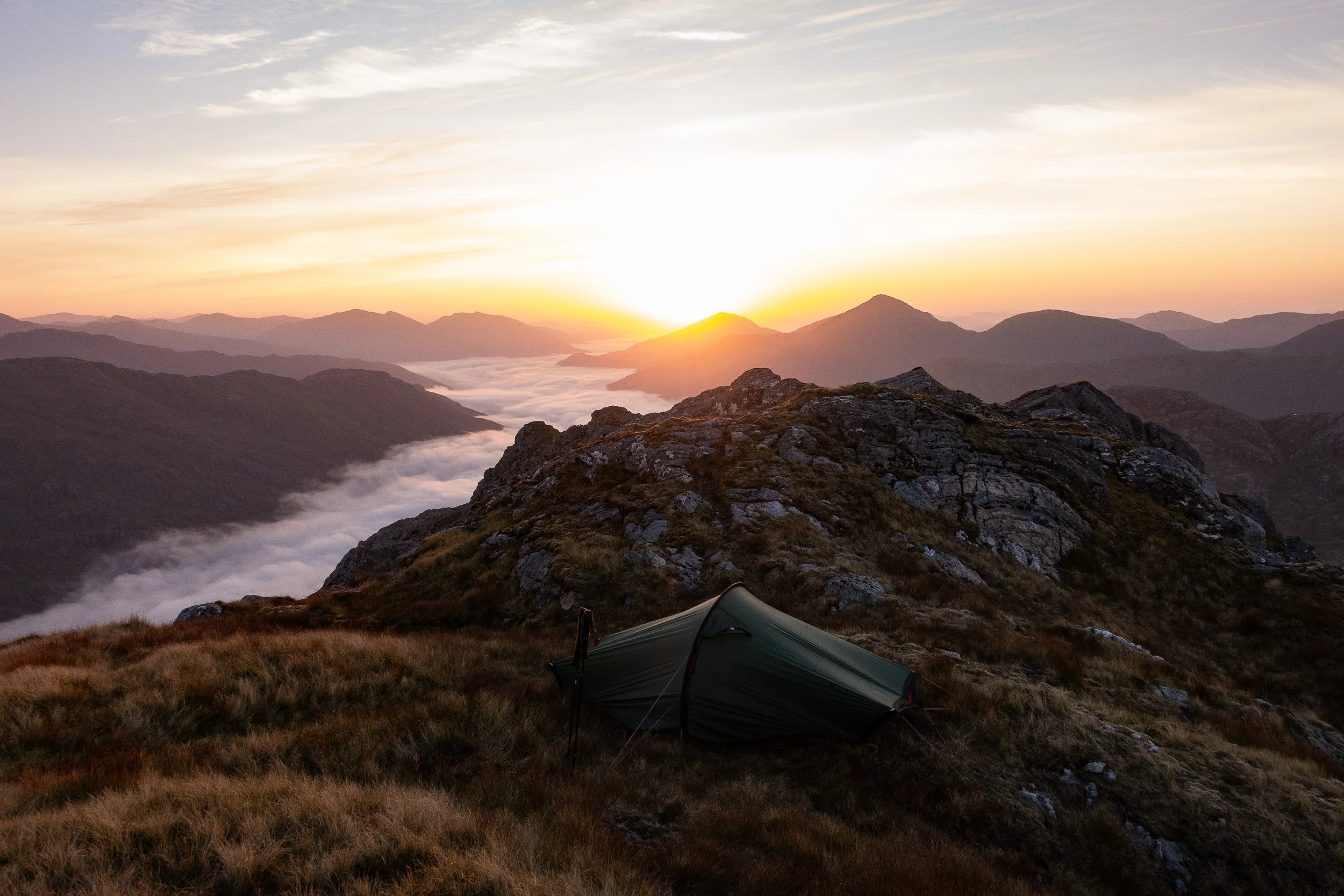
Scotland backpacking (2-3 season) - Equipment list
Recommended items of clothing and equipment for backpacking in Scotland in Spring, Summer and Autumn.
See also this Scottish winter camping kit list.
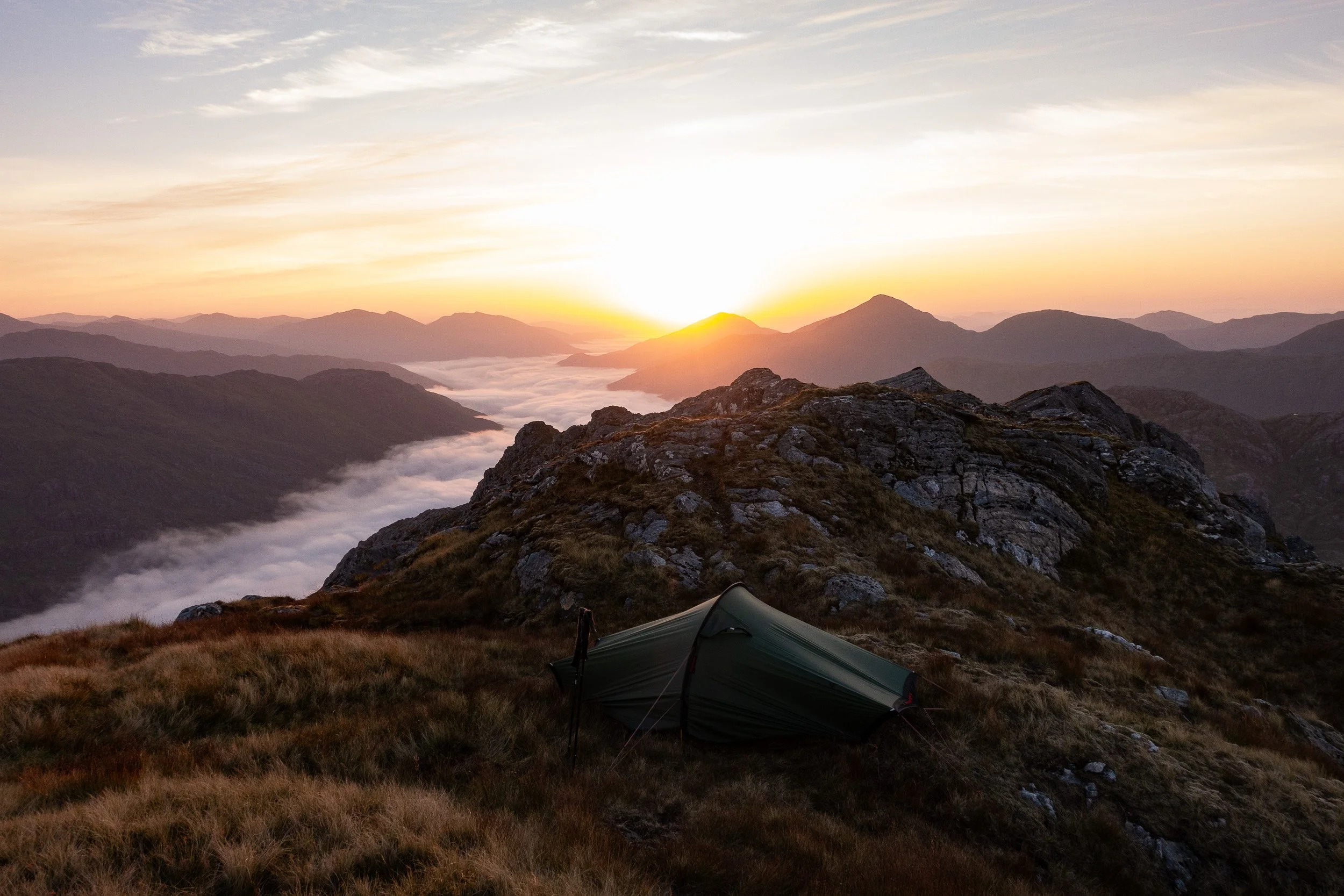
Wild camping in a tent above a cloud-covered Loch Cuaich (Quoich) at dawn from the summit of Beinn an Aodainn (Ben Aden) in the North-West Highlands of Scotland.
Despite not having high altitude, Scotland’s mountains and their maritime weather means that hypothermia is a real risk if you get soaked and chilled. Backpacking in Scotland can be a masterclass in compromise and whilst I imagine we all wish to experience warm sunshine and light winds as we travel with dry feet up remote glens and across rocky ridges, the reality of the Scottish Highlands - even between May and September - can be a relentless mix of bog, midges and ticks, sideways drizzle and strong wind gusts that will test every aspect of your clothing and equipment.
This is a kit list I’ve used for many years backpacking in Scotland over three seasons (Spring / Summer / Autumn) suitable for, say, the Cape Wrath Trail or the Skye Trail or 2-5 days Munro camping adventures - where my goal is to carry as little as possible, whilst still remaining safe, or to reduce the weight of what I do carry to the minimum (£ aside). It’s not an ultra light-weight backpacking kit list. Rather, it’s focused on durability, moisture management and keeping pack weight sensible without sacrificing safety and it includes small things that aren’t essential to take but which I’ve found are highly useful (such as e.g. a glasses case).
If you’re buying for a backpacking trip in Scotland, I’d suggest to focus on buying the best items you can afford - checking out second-hand options on e.g. eBay. And apply just as much consideration to your strength and fitness. Plus consider the value of everything you take (to you) versus the weight.
Wear
Underwear — A choice of lightweight synthetic or merino wool briefs, the latter of which I prefer for multi-day trips because the wool doesn't smell as much as synthetic fabrics after multiple days without a shower. It’s sensible to shy away from cotton - once it gets damp with sweat or rain, it stays damp and will chafe something terrible.
Trousers — I like trousers that dry quickly, helped by the wind. Popular choices on Scottish hills are lightweight, stretch-woven softshell trousers such as those by Montane (Terra series) and Mountain Equipment (Ibex). I have a similar pair from North Face that have a nice amount of stretch in them.
Socks — Bridgedale socks perfectly fit my size 11 feet. High-density and quick-drying wool, they provide both comfort and support.
Footwear — For a two to three-day trip I’ll consider trail running shoes, accepting that I’ll likely get wet feet. (Scarpa Spin Ultras I’ve found to be very comfortable). Waterproof socks can help but, personally, they make my feet very warm. A leather or synthetic boot gives better ankle support over the rough river crossings, tussocky grass and hillside traverses you’ll encounter in Scotland but almost certainly your feet will still get wet, through the big hole in the top. My advice would be to prioritise quick-drying fabrics and focus heavily on foot care. (Waterproof boots take ages to dry).
T-shirt — Hooded sun tops are popular in 2026 with the fabric providing protection from UV rays. I don’t have one, my choice being a simple short-sleeve base layer, which I’ll supplement with arm warmers if it’s colder or the sun is strong. Merino wool or synthetic again are my two choices of fabric, with merino wool managing odours better over a multi-day trek; synthetic fabrics drying quicker. Brands I’ve used include Artilect (M-Sprint), Patagonia (Capilene) and Montane (Dart). The arm warmers I prefer for three-season use are from Decathlon (Van Rysel brand).
Cap — A brimmed cap is handy to keep both the sun and sweat out your eyes plus it protects the crown of your head from the sun. A cotton baseball cap will work but a more pliable synthetic fabric I’ve found is easier to pack away when it’s not being used. Check out models from running brands such as Ron Hill, Inov8 and Vaga.
Backpack — A 50-litre rucksack I’d propose is an optimal balance between size and weight. If you need more, consider whether you really do - longer trips may warrant it as you’re carrying more food - or perhaps put some items in a waist pack). I like minimal features in a backpack plus side straps that enable me to attach my tent to the outside of my pack. Anything over 1.5kg I’d suggest is unnecessary heavy. In that regard, I rate Aiguille Alpine’s climbing packs which are very simple, have nothing unnecessary on them - hence they’re lightweight - and I find them super comfortable. (I use a customised Stratus version with a floating lid, which is 37+8 litres, or their Zenith model at 47+12 litres. Both packs are slightly larger than indicated, due to an XL back length).
Optional;
Extra pair of socks — A common tip is to carry an additional pair of socks for walking, which you rotate, drying one pair on your pack. Often though I’ve just ended up with two wet pairs of socks and I prefer just the one pair for walking, squeezing out the moisture as needed. If you have breathable footwear they’ll dry fairly quickly. Be mindful of blisters and take advantage of opportunities to remove your socks and shoes and air them.
Trekking poles (recommended) — Useful for saving your knees on steep descents, testing bog depth and maintaining balance during river crossings. I always bring them, prioritising lever-lock mechanisms over twist-locks, which I’ve found tend to slip when wet. Running poles are ideal (e.g. Alpkit Carbon Marathon Poles) but not as strong as dedicated hillwalking models. Careful use however should see them last a long time.
Gaiters — Personally, I’ve not worn gaiters outside of Winter for many years.
Warmth
For backpacking, there’s a fine balance I’d propose between clothing warmth and sleeping bag warmth. As in, it’s nice to have a warm jacket to stand around in, in camp, but if it’s too warm to walk in - and your sleeping bag’s appropriate for the conditions - you’ll be carrying more weight than you need. This is not always a bad thing. In cold, wet weather I far prefer having too much insulation rather than not enough.
Fleece top — A thin, lightweight fleece is useful, in all seasons. I like Mountain Equipment’s Lumiko model (the hooded version).
Insulated jacket — Imperative in Spring and Autumn (and in Scotland, often Summer). Buy one with a hood, which adds a lot of warmth, and ignore down fillings unless the forecast is stellar, given down collapses when wet. I’ve owned numerous synthetic insulated jackets over the years and found Primaloft Gold is very warm for its weight, Primaloft Silver not so much. The models that have stood out for me have been Rab’s Xenon Hoody, Haglöfs’ Barrier Zone Hoody and Rab’s Generator Alpine.
Hat — If I have a hooded fleece and a hooded insulated jacket, I’ll consider whether I also need a hat. If yes, Powerstretch fabric (used for hats and balaclavas) is light and warm. Rab’s Filament Beanie doesn’t use Powerstretch but I’ve found is also a good option, having different weights of fleece inside, the same as the Lumiko fleece above.
Gloves — Thin Powerstretch fleece gloves. They will get wet, but they retain warmth and dry quickly.
Optional;
Windshirt — A super-light Pertex windproof layer keeps the wind off without making you sweat like a hardshell does.
Buff — Useful for covering your face if it’s really wet, windy and cold.
Wet
For the lightest options, and in the nicest weather, look at running waterproofs such as those by Inov-8 or Montane (commonly using Pertex Shield). Just be aware of the risks - especially in colder weather - because in extended rain it’s very likely they will not keep you dry. Neither though will more expensive waterproofs - you’ll always get wet from the inside - but the latter will usually last much longer before wetting out with the thicker fabric offering more protection. Goretex Paclite I’ve found to be a good middle ground for a mixed forecast.
Waterproof top — The most protection would be a 3-layer Goretex hardshell (e.g. Mountain Equipment Lhotse, or similar models from Rab or Montane). Jackets made with Paclite Pro or the original Paclite are also suitable for three seasons. For all, look for a wire-brimmed, fully-adjustable hood that won't blow back off your head in a headwind and robust storm flaps over the zips. I also appreciate a decent-sized outside pocket, that will easily fit a map.
Waterproof trousers — Prioritise models with full or 3/4 side zips so you can put them on over boots without taking them off in a downpour. I’ve used Berghaus Paclite Pants for over a decade, across all seasons. Highly recommended.
Dry bags — Pack everything you want to keep dry inside your rucksack inside lightweight dry sacks (e.g. Sea to Summit or Exped). Years ago, I slept in a sodden wet sleeping bag and vowed I’d never again rely on a backpack rain cover to keep things dry.
Optional;
Waterproof shell mitts — If it’s forecast to be cold and wet, I’ll bring Goretex Paclite mitts from Extremities (Tuff Bags) which offer good wind / waterproof protection in a lightweight package.
Hydration and nutrition
Water bottle — Treadlite Gear’s bottle pouches are really useful for carrying water up front on a backpack, mimicking the functionality of a running pack (which enables you to access your water bottles without taking your pack off). I’ll carry x2 600ml Smart water bottles plus electrolyte tablets from Sports in Science or Nuun. As a bonus, the electrolyte tablets are fizzy and taste very nice.
Food — For backpacking, I like simple, easily repeatable meals. I have used the following for many years. (To add some variety, refer to this Reddit thread on backpacking meal ideas). The bags they’re packed in double as rubbish bags.
Breakfast - Granola cereal and skimmed milk powder. Just add water.
On the move / lunch - If I’m on my own, I’ll generally just graze throughout the day on calorific treats rather than stopping for lunch; carrying a mixture of texture and taste such as e.g. M&Ms, raw fruit & nut bars, fudge pieces, wasabi-coated peas, etc. If I’m with others, I’ll take a roll or oatcakes with cheese or vegetarian pate for lunch and less snacks. Jelly beans make it into my pack regardless and are much welcomed at the end of a long day, by both me and my companions.
Dinner - Packet soup (minestrone) plus this Rice and Beans recipe from Andrew Skurka which is light and super tasty. Doritos is a good replacement for the Fritos, sealed from the air for freshness, and I’ll use parmesan cheese if I’m out for more than two nights. (Santa Fe instant beans are available in the UK from Shayona). More expensive mealtime options are freeze-dried meal pouch options (e.g. Summit to Eat, Firepot), available in outdoor shops and online from e.g. Base Camp Food. For dessert, I’ll carry some small chocolate bars, valuing the simplicity of Cadbury’s Freddo Frogs, despite being in my mid-fifties.
Safety
Navigation — Map and compass. Ordnance Survey (1:25k or 1:50k) or Harvey Maps covering your route, protected in an Ortlieb waterproof map case. Don’t rely solely on a mobile phone. A lot of the Scottish Highlands has poor cellular connection (in my experience, with O2) and its best to know where you are without having to check a computer.
Mobile phone — If I’ve not chosen to use it as a camera, I’ll keep my phone switched off and stored in a dry bag. Downloaded onto it is the Sarloc mobile app, developed by Russ Hore, a former Mountain Rescue team member. I’ve also registered my phone for calling 999 by text, i.e. emergency SMS. The iOS version on my phone also enables emergency SMS functionality.
Headtorch — I’m not expecting to be navigating in the dark when camping but I still want to be able to do so if needed so I’ll carry a Petzl Bindi head-torch, which I’ve found to be a great balance between weight and usability.
Optional;
Mobile apps — I like the OS Maps app from Ordnance Survey, which I’ll use as a backup to my map and compass. It’s not perfect - I’ve commonly found tiles which are out of date compared to e.g. Walk Lakes GPS mapping software.
GPS Watch / Navigation — A modern smart watch (e.g. Garmin Fenix) is capable of tracking OS grid references, distance and elevation, which is very useful, and I use mine all the time, but I don’t class it as essential - outside Winter anyway - given it isn’t my sole method of navigation.
Messaging device — A satellite messenger (such e.g. Garmin inReach). I’ll always carry one but it’s not 100% essential given my phone has the functionality too. I prefer though redundancy in equipment, especially when I am out on my own.
Powerbank (Recommended) — I use Nitecore’s 10,000 power brick, which is light and powerful.
Cables — I’ll carry a USB-C, USB-A plus a Garmin adapter for my watch.
Personal care
Suncream — Sunburn is not a good look, nor good for health. I’ll apply factor 50 liberally, throughout the day, being conscious to cover my lips and ears as well as my face and neck.
Sunglasses — Possibly optional (I’ve never carried any in 25 years of backpacking).
Insect protection — Protection from midges is essential in Scotland. A fine mesh head net (specifically a midge net, as mosquito nets let them right through) and Smidge spray does the trick, along with tucking your socks into your trousers and wearing your gloves. Other annoying insects are ticks (yeuch), prevalent in long grass and bracken, and deer ked (double yeuch) and horsefly. I’ll always carry tick tweezers when camping.
First aid kit — Not as big a first aid kit as in Winter but enough to cover e.g. blisters, burns and bites. (Mine includes strong painkillers, loperamide, zinc oxide tape and antiseptic wipes).
Toiletries — Toothpaste tablets and a brush, toilet paper, soap, lighter and a trowel.
Sleeping
Tent, poles and pegs — Popular in 2026 are tents that accommodate trekking poles instead of tent poles. This could save you c.300 grams (an approximate weight of two aluminium poles) as long as you’re already carrying trekking poles. What happens though if you damage a pole? (I’ve broken a lot of trekking poles). I appreciate it’s unlikely you’d break two. Expensive such tent models include Thurston and Hyperlite Mid but see also Simond for a cheaper option. I hiked the Cape Wrath Trail - most of it anyway - with a 1-man tent from Argos, which cost me £29.00 - 50% off in a sale. It was said to be a direct copy of a much more expensive Sierra Designs model and it was excellent until I retired it due to the weatherproofing coming to the end of it’s life. In it’s place, I purchased a Hilleberg Akto tent which I really like and use all year round.
Sleeping bag — I spent four days on a backpacking trip in Scotland in May in a one-season down bag which I thought would be warm enough but proved not to be when I woke up every night 2 to 3 hours after going to sleep (and sometimes 2 to 3 hours after that) due to the cold. I vowed not to scrimp on a sleeping bag ever again (although one one winter camp atop the summit of a Munro above Glenfinnan had me questioning my decision-making as I lay in my sleeping bag with my thickest insulated jacket on and I was only just warm enough without moving). A synthetic bag or a hydrophobic treated down bag rated to around 0°C to -3°C I’d suggest is ideal for Spring and Autumn. It’s not overly heavy for Summer.
Sleeping mat — Ground temperature saps body heat and an appropriate rated (R-value) sleeping mat makes a big difference. Cascade Designs’ Thermarest models are expensive but totally worth it, in my opinion. I use a X-Therm which is overkill outside Winter but I’m still happy to use it all year round because it is smaller and lighter than a three-quarter sleeping mat I had previously. If I was starting again. I’d likely look Therm-a-Rest’s NeoAir XLite (and carry a Ridgerest for Winter if I felt it was needed).
Cooking — Stove, gas, pot, lid, spoon - Alpkit’s Kraku stove is tiny and I’ve found it perfect for three seasons. It replaced an MSR Pocket Rocket, the second version of which fits neatly into a cooking pot. Imperative I’d propose - to keep the flame on and optimise gas - is a windbreak such as the Optimus clip-on windshield. (Research this fully if you want to use one - you don’t want to be fully enclosing a canister-mounted stove from the wind, for safety reasons). Pot-wise, I’ve had a long-term camping relationship with an MSR Titan kettle which is super expensive but will outlast me (cheaper options are available from Alpkit and eBay) and a Light my Fire titanium spoon which cost £18 at the time - for a spoon! - but is very nicely designed. Plastic spoons are also available. For fuel, a 100gm gas cartridge will last me 4 days or more, regardless of season.
Spare clothes — Arguably these are optional for Summer but the minimum I’d propose for Spring / Autumn, for comfort and safety reasons, would be spare underwear (e.g. Rab Syncrino), a lightweight pair of leggings (Patagonia Terrebonne Joggers are ideal), wool socks and a base layer. Pack these in a dry bag, along with your sleeping bag.
Optional;
Repair kit (Recommended) — Things always seem to fail when you least want them to (e.g broken laces, punctured sleeping mat, broken tent pole). Consider how you’ll fix the key things that matter to you and carry the means to be able to. Focus on the highest risks; you don’t need to carry the means to fix everything (but you’ll be frustrated when the thing that breaks is the thing you don’t have any repair items for. In that case, you’ll need to be resourceful).
Water filter / purification — A lightweight squeeze filter (Katadyn BeFree)
Kindle — Or a similar electronic reading device. You can use the app on your phone (useful for podcasts too) but, batteries. Or perhaps not read at all.
Microfibre cloth — A small piece of cloth, useful for drying the inside of your tent floor if it’s been raining or the ground has been wet.
Glasses case — A light plastic case. I’ve bent many a pair of glasses from rolling over onto them.
Water — A 2-liter collapsible bladder for camp. Highly recommended for summit camping as you need to carry more water up the hill.
Photography
I’ll use my mobile phone more for photography in Spring, Summer and Autumn than I would outside of winter, as the battery lasts longer (I’m not simply carrying my phone for safety). Not in the wet though as the touch screen isn’t reliable when it has water on it. No matter what the weather though, it’s unlikely I’ll take my professional camera gear when backpacking - unless perhaps camping on a summit - and my happy medium for photography is Sony’s RX100 compact camera, which is ideal for me in regards to quality versus weight.
Mountain safety
If you’re new to the outdoors, ensure you have the skills to be able to cope. Mountaineering Scotland offer resources and courses to help you on your way, such as;
Leave no trace
Your goal should be to leave the outdoors as you found them and protect the environment for future generations. Support this by following these seven Leave No Trace principles.
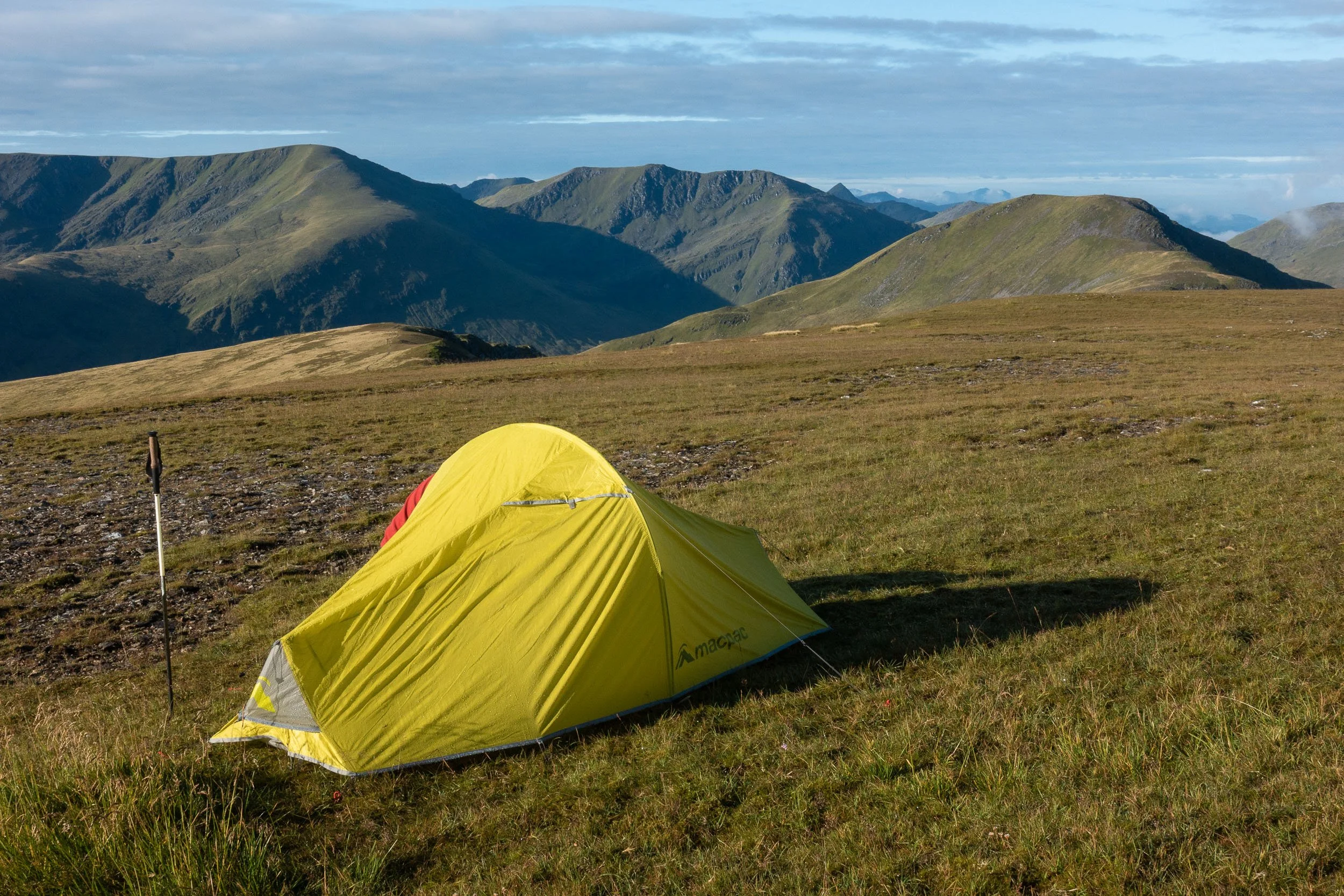
Perfect ground for backpacking near the summit of Moruisg in the North-West Highlands of Scotland. We’d wild camped the previous evening on a bealach in the distance and this was our third (and last) Munro of the day. My tent is pitched just behind me.

Winter hillwalking in Scotland — What to take
My clothing and equipment list for winter hillwalking in Scotland’s Munro mountains.
A companion post to my Scottish Winter camping kit list, with some updated thinking on clothing. As before, it’s not a super lightweight gear list but I’m proposing my choices are a good balance between weight and durability.

Scottish Winter weather can be unforgiving. Having the right clothing and equipment helps to make it safer and more enjoyable.
There’s two quotes I recall that I relate to Winter walking in Scotland, one which is “There’s no such thing as winter hillwalking, it’s all mountaineering” and the other being “On the coldest moment of the trip, if you aren’t wearing everything you brought, you brought too much”. (The latter to which I’d propose adding “Unless you're too cold”).
Winter walking in Scotland’s Munro hills is hugely fun, if you’re prepared for the mixed and often wild weather that will be thrown at you (which is indeed part of the fun). The below is a list of things i like to carry to help keep it that way. On top of this is navigating carefully and being hill fit so I can expend the least amount of energy across the ground I’ll cover, with the start of every year reminding me that deep, soft snow is really difficult to travel through.
Wear
Underwear — I prefer Merino wool for its odour-prevention properties and warmth. A heavier material helps to keep everything warm.
Trousers — Powerstretch tights are ideal, if not overly flattering these days as they’re super tight (tights). I have a looser pair of Karrimor Powerstretch leggings with pockets that are 20 years old and have many small holes in them but I’ve found nothing better. Soft-shell trousers are popular but are often fairly heavy. If you don’t mind wearing your waterproof trousers all day, a decent fleece layer may be all you need.
Socks — Wool is best, I’d propose, with Bridgedale’s 4-season models fitting me perfectly in size 11.
Boots — I use La Sportiva’s Nepal Extremes for the warmth (a friend rates Scarpa’s Mont Blanc Pro model). Both however are what’s termed as B3 boots and are overkill for basic hillwalking. Ask your local outdoor shop about for B1 and B2 rated boots (such as Scarpa Mantas, which I’ve always rated but they are now more tech-orientated and I’ve not used them for a long time). I’d then suggest that you buy any suitable boots from that shop, rather than online, so the business is still there the next time you need advice.
T-shirt — Merino wool for me (Artilect’s M-Sprint which, at 115gsm, is super light and dries fast). I’ll add arm warmers or replace it with a thicker, long-sleeve base layer if it’s colder.
Backpack - I highly rate Aiguille Alpine, a Lake District-based company, their 37-litre Stratus model being my choice for winter day walks. It’s a climbing pack, so somewhat tall and thin, but it’s super comfortable, even with heavy weight. Owner Adrian will modify it to your needs - I had a floating lid added, extra-long side straps so it suits winter backpacking (it will accommodate a tent) plus a loop on the hip fin where I can insert my ice axe, for ease of access.
Warmth
Fleece top — A 100-weight fleece top offers a lot of warmth for the weight, even more so under a windshirt.
Windshirt — I rate Patagonia’s Houdini windproof because it’s got a hood, but it would be better if it had cinch cords at the front. You can use your shell jacket instead and save carrying that weight but a windproof is much more breathable. I usually wear this from the start but it’s light and small enough to carry if the sun’s out and you’re too hot.
Fleece or softshell jacket — I still rate Rab’s Winter Guide jacket but it was discontinued back in 2022. It’s very heavy (850gm) but it has a nice ‘bomb-proof’ feeling about it when I put it on (as long as there’s a windproof layer on top - I find the Vapour-Rise fabric, despite Rab’s marketing claims, to be not very windproof at all). There was a later version which was a bit lighter but I imagine you’d always prefer to be wearing one than carrying it. The current (2024) Vapour-Rise Summit jacket unfortunately I find too light and a middle option might be Patagonia’s Nano-Air Hoody, but it’s expensive and a thick 200 weight fleece will definitely do (I used a Berghaus Spectrum pullover for many years).
Insulated jacket — A jacket to keep me warm when I’m stopped and for wearing in the worst weather. I’d recommend Rab’s Generator Alpine for a good forecast and for backpacking and Mountain Equipment’s Citadel jacket for a day walk, or perhaps their Fitzroy model as a ‘do it all’ alternative. If I’m planning to be a long way from the road, I’ll also consider a pair of Mountain Equipment Compressor Pants.
Insulated trousers — Mountain Equipment Compressor Pants if I’m expecting to be far from the road for a considerable period of time. Only carried in case of extended stops / emergencies.
Hat — I prefer a thin head-band as it is not as hot as a wool hat. Dynafit are good but I’ve found them often difficult to source in the UK. Decathlon’s Van Rysel brand I’d suggest is a good alternative. With both, I’m mindful the crown of my head doesn’t get burnt from the sun. For a second ‘storm’ layer, I’ll carry a powerstretch balaclava, opting for a windproof version from Mountain Hardwear if the weather is forecast to be especially wild.
Buff — Any model will do. I have a Celtman-branded one, which is made of a shiny nylon, plus a cycling one from Castelli, which is more like a thin fleece. I prefer the latter.
Gloves — Rab Powerstretch or Montane Trail Lite gloves I find to be an excellent first layer but they’re thin and not windproof so they’re best suited for lower down. Waterproof gloves are an option for a heavier layer but I’ve always found when they get wet they stay wet (sometimes for days afterwards). My current choice is a Mountain Equipment Randonee glove, a soft-shell glove with a pile inner which I’ve found to be excellent. If they do get too wet, I can just squeeze the water out of them.
Insulated mitts — I like a third layer for my hands, for emergency purposes. My preference would be a pair of thick Primaloft mitts, such Mountain Equipment’s Citadel Mitts, but they don’t fit me and their Fitzroy model Mountain Equipment no longer make. I’ve not yet found any suitable alternatives. I’m using instead a long-discontinued pair of sheepskin mitts from Extremities that have a separate, thick outer waterproof shell. They’re not light but they’ve proved themselves to be more than warm enough during a very long open Winter bivvy.
Wet
Waterproof top - I switch between a Mountain Equipment Lhotse and a Montane Ajax depending on the moisture expected. (The former is a neater fit so I wear a belay jacket over the top. The latter I can fit it underneath my shell jacket in wet weather if need be but I’d have to be very cold to want to do this). I don’t think you’d go wrong with any of the 3-layer versions from Montane, Rab or Mountain Equipment, all of which have hoods they have optimised for UK Winter weather. (The protection from any hood I’d propose shouldn’t be underestimated).
Waterproof bottoms - Berghaus’ Goretex Paclite Pants I’d propose are a good balance between too heavy and too light. The assumption being you’ll be walking with a good forecast. Goretex Paclite Plus or 3-layer Goretex are the more bombproof options for livelier weather. If you’re male, prioritise a covered front zip, so you can urinate without taking your trousers down. (Women perhaps too, if using a Shewee).
Waterproof shell mitts — For me, covered by my insulated mitts above. If not, Goretex Paclite mitts are light and protective.
Gaiters — Essential for wet ground and/or when there’s lots of fresh snow around. I prefer to wear gaiters these days rather than carry them, using a comfortable older pair from Rab.
Dry bags — Anything you don’t want to get wet will get wet unless it’s protected in a dry bag. I have a mixture of sizes from Exped and Sea to Summit.
Hydration and nutrition
Water bottle — Treadlite Gear’s bottle pouches give me access to water up front without taking my pack off, similar to a running vest. Their marketing says the pouches can accommodate up to a 750ml water bottle. I switch between a 600ml Smart water bottle and a 500ml Nalgene. I’ll also carry a 1-litre Nalgene, which I find simple to use with big gloves on. Arguably you don’t need both, but I like to keep hydrated.
Flask — I don’t always take a flask and, if I’m on my own, I’ll sometimes take an MSR Windburner stove instead because the weight is equal, sans the liquid, and I can use it more than once. When I’m walking with others, few wish to sit around in the cold waiting for a stove to boil so I’ll take a Thermos Ultimate flask for a hot drink (my preference being diluted orange juice with a pinch of salt).
Food — Calories are especially important in Winter and I’ll split my food into two categories - on the move and stopped. The former is quick-hit sugary treats such as jelly beans, skittles, M&Ms or soft fruit/nut/date pieces (Alesto snacking fruit packs, available at Lidls, are spot on) and the latter is e.g. a roll or two with a calorific topping such as peanut butter and banana, or cooked vegetarian sausage (great with tomato sauce), or oatcakes with cheese or vegetarian pate. I’ll take more food than needed to cover any unplanned emergency situation.
Electrotye tablets - Electrolyte tablets (e.g. from Science in Sports or Nuun) are designed to help maintain proper fluid and mineral balance, useful for winter hillwalking where heavy layering, cold air and physical exertion can cause significant loss. I’ll carry a small half-sized tube, periodically adding a tablet to my water when I fill up.
Safety
Minimum;
Map / waterproof case — Essential and I’ll take two maps in Winter so I have a spare.
Compass — You likely won’t need two compasses but I lost one once - it came off around my neck - so I carry a lightweight spare (Silva Field). Their Expedition 4 model is my first choice.
Headtorch — I use Petzl’s Nao+ model, with either one or two batteries depending on how far I plan to be from the road. I might also take a Petzl Bindi as a backup.
Phone — I’d recommend downloading the Sarloc app, which was developed by Russ Hore, a former Mountain Rescue team member, plus registering your phone for calling 999 by text, i.e. emergency SMS. Modern mobile phones are highly water resistant but I’ll always carry it in a dry bag or waterproof case, and either turn it off or keep it somewhere close to my core so it’s warm and the battery doesn’t die quickly. (Airplane mode is your friend).
Powerbank — I use Nitecore’s 10,000 power brick (10,000mAh = 6,400mAh) plus carry the appropriate cables to charge my watch, mostly, plus my iPhone and inReach.
Ice axe — Petzl’s Summit 59cm is my default ice axe but if I don’t anticipate needing it, or using it very much, I’ll carry a very lightweight Petzl Ride, accepting a risk that it’s not optimal for ice axe arrest
Crampons — I have an old pair of Grivel G12 crampons, which are blunt and heavy. I’ve sharpened them many times but the latest G12s, and other models such as Petzl’s Vasak crampons are attractive, as they’re much lighter. Ten point crampons such as Grivel’s G10 might also meet your needs.
Blizzard bag — Blizzard’s Active Range (2-layer) I feel is a good choice for the Scottish Highlands. I have the survival bag but I imagine in a true emergency scenario I’d be cutting it into a blanket (picturing it would be difficult to get me or someone else inside with, e.g. a broken leg or ankle).
Bothy bag — It could be argued this isn’t required if you have a Blizzard Bag but I’d never go out without both. The protection you can get from a bothy bag (having sat in one for over 12 hours, wishing I had a blanket as well) is remarkable. I’ll carry either Terra Nova’s 2-man bothy, or if the forecast is benign possibly a Supalite Bothy Bag.
Ski goggles — I have a cheap pair which I’ve had to glue the foam back on a few times. Spending money on a decent pair would be sensible but googles are something I’ve found I rarely need to use, and the ones I have are functional, so I’ve never got round to it.
Recommended;
OS Maps app — Amazing, easy to use app as a back-up to your map and compass and a bargain as regards to price versus benefit.
Watch — I use a Garmin Fenix 5 model which I’ve programmed to display my grid reference, altitude, distance walked and speed on the front screen, which I find invaluable. Occasionally, I’ll upload a GPX file I can follow if need be, depending on the complexity of the route.
Garmin inReach — I like going out on my own and having a means of communicating back home is useful, as is the emergency response capability, for absolute worst case scenarios. The latest Apple iPhones have satellite messaging, which could be argued makes an inReach redundant, but the battery life is much longer and I’m happy to carry both as I don’t like to rely on a single such safety item. Garmin’s 2024 cost model changes, so you only have to pay monthly for the emergency element (with e.g. texts and weather forecasts chargeable), is ideal for my purposes and makes it a lot more affordable (handset cost aside).
Trekking poles — Walking poles make travelling in snow so much easier, as well as river crossings. I’m currently using a pair of Alpkit Carbon Marathon poles. They aren’t bombproof - I’ve broken one pole and the clasp came loose on another - but they’re fairly robust and nice and light.
Personal care
Suncream — SP50+ is the minimum I consider taking outdoors. I’ve been quite badly sunburnt three times and I have no wish to have this happen again.
First aid kit — I’m always considering risk in Winter and my aim is to need no first aid but I’ll always carry a decent-sized kit that covers blisters, mild to heavy bleeding and breaks. Anything major, especially if I’m on my own, is going to warrant emergency decision-making.
Nose/lip balm — Not essential by any means but my nose runs constantly outside in the Winter (okay, from October) and this saves me have chapped skin for days afterwards
Photography
’ll choose from one of the items below for photography;
Mobile phone — Occasionally I’ll rely solely on my phone (e.g. if the weather forecast is poor and I don’t expect to do anything with the photos) but I prefer to keep it for emergency purposes
Sony RX100 — A great balance between lightweight and quality outcomes. I’ll carry a spare memory card, battery, dry bag and Lenspen. Difficult to use as anything other than a point and shoot with big gloves on but not impossible.
Nikon D810 - Carried in a Lowepro Toploader Pro camera bag. Love it but it’s heavy with a 24-70mm f2.8 lens attached, and sometimes a 70-200mm f2.8 in my bag, so I’ll keep it for when I anticipate good photography opportunities (which doesn’t mean blue skies, stormy weather is much more interesting). There’s no need for me to carry a spare battery unless I’m out for a few days.
GoPro Hero 8 — The opposite to the above in that it needs lots of batteries (x3 standard batteries at least for a winter’s day out and even then I’m caught short when the battery gets cold and it dies in minutes). I’d like the Hero 9 or later, which are compatible with GoPro’s Enduro battery, which has a vastly better battery life in cold weather.
New to going out in Winter?
I’d recommend Mountaineering Scotland’s ‘Think WINTER’ campaign, especially the sections on Navigation, Skills and Avalanche.

Still the windiest day out I’ve had on a Scottish hillside, where we were driven to our knees on a 25-degree slope. Only Patagonia has come close.

Winter camping in Scotland — Gear List
Recommended items of clothing and equipment for a winter camp in Scotland’s Munro mountains.
Note - This is not a lightweight winter backpacking kit list. It’s optimised for a walk into a fairly remote location (e.g. in Scotland, c.2 hours from the road) where you’ll pitch your tent in place and have two day walks with two static wild camps overnight.
See also this Scottish winter hillwalking kit list, which is more suited to day trips.

Winter tents camped on the snow at sunrise near the bealach beneath Meall nan Teanga and Sròn a’ Choire Ghairbh, two Munros above Loch Lochy in the West Highlands of Scotland.
Far too early in the year (usually from October), I look forward to winter camping in Scotland. People often find this strange because I’m not talking about the deep, cold snowy winters of, say Alaska, but the bone chilling, ‘just-above-freezing and the sleet’s blowing sideways’ maritime climate that Scottish hillwalkers rejoice in.
Winter camping in Scotland can be cold and very wet. We don’t live in a big country but it’s possible to get far away from the road and relative safety (some roads in winter have no traffic) and with the wind, snow and often close-to-freezing temperature of the rain it would be easy to get hypothermia. It’s important to have the right skills, quality equipment and to be prepared.
Here is a sample winter camping kit list for coping with Scottish winter conditions, with some gear thoughts and tips from 25 years experience thrown in.
Wear
Underwear — Synthetic shorts (or merino wool, which doesn’t stink as much after a few days out). Definitely not cotton.
Trousers — Softshell trousers are popular. I’ve tried lots and prefer Powerstretch leggings (think stretchy fleece tights — not for the fashion conscious).
Socks — Thick woollen socks (e.g. from Bridgedale or Smartwool). If you wear leather boots, waterproof/breathable socks can be useful if it’s forecast to be wet underfoot — look for ones with merino wool inside.
Boots — Scarpa Mantas used to win Trail magazine’s ‘Best in Test’ award most, if not every year. I like La Sportiva’s Nepal Evo GTX model for big snow days (although they’re more suited for climbing than walking, they’re waterproof and very warm) and Scarpa Mescalito Trek Pro for occasions when it’s still winter but the conditions are more alpine in nature.
T-shirt — Merino wool (mixed reviews — I like it) or Patagonia’s Capilene fabric. Long-sleeved for warmth and versatility (i.e. with the sleeves rolled up).
Backpack — If you don’t take the proverbial kitchen sink, your pack needn’t be more than 65 litres (in my opinion.) I use Aiguille Alpine’s Zenith model which at 47+12 I find optimal. (It’s probably slightly bigger as I had it made with a long back length). I previously had their Verte model - 65+15 litres - and it was HUGE - I’m 6’2” and it towered above my head. Based in the UK’s Lake District, Aiguille Alpine made my pack to order and customised it on my request, with extra-long side straps, a loop on the hip fin for an ice axe, plus slightly bigger wand pockets so they will accommodate a Nalgene bottle.
Warmth
Fleece top — A lightweight fleece pullover, 100-weight, is ideal as a second line of defence.
Windshirt — Invaluable. I wear it over the t-shirt, or the t-shirt and fleece, and it keeps me warm on the move in most weather.
Fleece or softshell jacket — If the weather is particularly foul, I’ll use a Rab Winter Guide jacket. It’s not windproof enough on its own in a cold wind and it’s heavy to carry (which is the case most of the time as it’s too warm for me to walk uphill in it,) but under a shell it’s excellent as it offers a lot of protection when I need it (e.g. when I’m up high for a long period of time). Lighter options are available (e.g. a second fleece layer or a 60gm Primaloft top from Rab, Haglofs, Patagonia) but I’ve found the insulation in the latter compresses too much in a winter hoolie and I’ve been cold.
Insulated jacket — Mountain Equipment’s Citadel jacket is super toasty. (I’ve tried down insulation and don’t like it in Scotland in winter for camping trips, even with a water-resistant shell — it gets wet too easily and the insulation suffers). The Citadel jacket is far too warm to move for long in so I’ll occasionally replace it with a Mountain Equipment Prophet if the weather is forecast to be not too cold. (If I was buying new, I’d likely go for Mountain Equipment’s Fitzroy jacket).
Insulated trousers — Mountain Equipment Compressor Pants if I’m expecting to be outside a lot during the evening (e.g. taking photographs). A total luxury item but never a regrettable decision (and they enable me to take a lighter sleeping bag).
Hat — I prefer a thin nylon head-band (Dynafit or Van Rysel) as it allows heat to escape from the top of my head - anything fleece or wool is too hot for me to walk in. If I choose a hat, Inov-8’s All Terrain Peak Running cap has an uncanny ability to not blow off my head, despite strong gales. For a storm layer, I’ll carry a powerstretch balaclava which offers lots of head protection in a light package. Paired with the headband above and supplemented with the hood on my jackets.
Buff — Protects your face from the cold when the wind is strong and the temperature is around or below freezing. If it’s really bad I prefer a neoprene face mask (pairing it with the balaclava above).
Gloves — I’ll use thin Powerstretch gloves perhaps 80% of the time (which enable me to maintain the dexterity required to take photographs). They get wet but dry relatively quickly. I’ll always carry spare gloves and for a long time I used a pair of waterproof ski or mountaineering gloves from Black Diamond. They were great for poor weather but if I wore them for any period of time I sweated in them and they stayed wet for the duration and for days afterwards. I replaced them with a non-waterproof, soft-shell alternative - Mountain Equipment’s Randonee gloves - accepting the same outcome as my fleece gloves above - they will get wet but dry quicker.
Insulated mitts — Lightweight pertex/pile mitts (e.g. Mountain Equipment Randonee or Montane Extreme mitts), which I carry as spare for emergencies.
Wet
Waterproof jacket — Mountain Equipment’s Lhotse is ideal (or the Rab or Montane equivalent). I don’t choose a super lightweight option (such as Alpkit’s Gravitas model) which I’ll keep for summer or for days when it’s virtually guaranteed there will be no rain. Features-wise, I like two layers of fabric for the front zip, or else the wind/sleet/rain comes through it, plus a hood you can disappear into which has strong bungee cord at the back of your head for cinching it dow (many jacket hoods un-cinch in strong winds and any models that utilise a velcro strap for this purpose I’d propose are next to useless).
Waterproof trousers — Three-layer Goretex trousers (or Pac Plus) offer maximum protection. If you’re wearing thicker trousers, you could get away with a lighter pair of shell trousers but I’d caution lightness against robustness. I trashed two pairs of Goretex Paclite trousers each in a single season through heel rubbing before a friend gave me a tip - If your trousers don’t have a reinforced kick panel on the inside of your waterproof trousers, next to your heel, paint seam seal here. This strengthens this area dramatically. Consider also the value of a front zip, for ease of urination - males especially and perhaps women too, if using a Shewee. Ensure the zip is covered so there’s minimum chance of leaks (from the outside!).
Waterproof shell mitts — Paclite mitts from Goretex for wind/waterproof protection (worn over either my gloves or mitts).
Gaiters — Can almost guarantee dry feet, when used with waterproof boots, but if it’s not that cold, your feet may get hot and sweaty. To prevent this, seek out waterproof / breathable versions. Make sure the loop at the bottom is sturdy or it’ll break easily.
Dry bags — Absolutely imperative.. Anything you wish to keep dry, put in a dry bag inside your pack. Never rely on just a rucksack cover to keep the contents of your rucksack dry. (In fact, if you have a rucksack cover, I’d propose to just leave it behind. In Winter, it will likely just threaten to blow away all day).
Hydration and nutrition
Water bottle — A rigid 1l Nalgene with a wide mouth for on the move. Excellent when stopped as a hot water bottle (I put it between my legs, on the understanding that it’s warming up my blood as it’s travelling through my body) and I’ll also bring a 1.5 litre collapsible water bottle (e.g. Platypus). It’s nice to not have to walk back and forth for water.
Vacuum flask for hot drinks — I no longer take this (carrying the stove instead through the day if I think I would need it). A 0.5 litre flask though I’d propose would be a good combination of weight versus the amount of use.
Food — In Winter especially, calories are king. My goal is to always have energy for moving and to never be hungry in my tent.
Breakfast - Granola, milk powder and water for breakfast plus hot chocolate.
Daytime - Simple carbohydrates for eating on the move - i.e. sweets and fruit & nut pieces - morning and afternoon. (Jelly beans for the last few kilometres before camp perks me up no end.). Plus solid food for lunch that’s robust enough to live in your pack (e.g. oatcakes with cheese or Dr Karg crispbread + vegetarian pate).
Evening - For the last five years, every outdoor hot meal I’ve had has been Andrew Skurka’s Beans and Rice. Delicious and I’ve never failed to finish a bowl. Shayona sells the Santa Fe beans in the UK and I purchase dehydrated rice from Tentmeals which is expensive but worth it in my book for the (lack of) weight plus the speed of cooking (pour, stir and leave). A home-made dessert from custard powder, granola and apple slices is similar to that from e.g. Summit to Eat. I’ll supplement this with any leftover snacks from through the day, although I’ll never rely on these for my evening calories.
Electrolyte tablets — These help to balance the salts in your body. They’re useful for me given sweating in Winter is common, despite the cold. I’ll add a single tablet to the water I have on the move plus two tablets in 500ml for a concentrated mix when I get back to camp.
Stove, fuel, windshield — I own a few, all from Mountain Safety Research (Whisperlite, Windburner and a Pocket Rocket). For Scottish Winter, the Windburner is by far my default choice as it’s super easy to use, has it’s own pot and I can use it inside my tent vestibule with little risk of anything catching fire (always prioritising lots of ventilation so I don’t die of carbon monoxide poisoning). Look for winter grade fuel which is optimised for lower temperatures.
Pot — On the rare occasions I take my multi-fuel stove (MSR Whisperlite), I’ll take a lightweight 1.6 litre pot so I can boil a big pot of water and use it for multiple things, all at the same time (to save me reboiling water). My MSR Windburner model however is much simpler to use and comes with its own pot, which although small is perfectly suitable for drinks (which is all I’ll use it for because, in Winter, my main meal is ‘just-add-water’ freeze-dried options, as per above).
Spoon — Lexan or titanium
Lighter — Light my Fire fire steel
Safety
Minimum;
Map and compass — Essential, with the map protected within an Ortlieb waterproof case. Plus a spare of each if I’m on my own.
Mobile phone — In a dry bag, fully charged and switched off.
Powerbank — If/when you do use your phone, the battery will drop much quicker in the cold. Nitecore’s 10,000 power brick is very lightweight and ideal for camping, but it is expensive. Carry the appropriate cables (e.g. USB-C, USB-A, Garmin adapter) testing they work before you leave the house.
Batteries - AA or AAA if any of your equipment relies on them (e.g. GPS)
Ice axe — Petzl’s Summit ice axe (59cm) I’ve found to provide a good balance of functionality versus weight.
Crampons — Grivel G12s (10-point ones would suffice for winter walking).
Goggles — Not often used but essential when you need them, to be able to see clearly and navigate in a blizzard.
Headtorch — Petzl’s Nao+ model offers a lot of power and great battery life. (I do choose though to carry a spare battery, along with a Petzl Bindi model for use around the tent).
Bothy bag — An essential piece of gear for emergencies if you’ll be away from your tent all day - so you can’t rely on that — but also great for lunch stops in the wet or wind. (A 2-man model fits you and a dog. A 3-man is better I’d propose for 2 adults).
Blizzard bag — I’ve never used this but if the marketing’s to be believed, it’ll be as warm as a 2-season sleeping bag. (I imagine it won’t).
Recommended;
Repair kit — Consider what you’d do if a key piece of equipment failed (e..g. boot lace, crampons, sleeping mat, tent pole). Ensure you have the means to fix it.
Trekking poles — With their weight in gold I’d propose when negotiating deep snow or snow-covered rivers. Collapsible aluminium poles (e.g. Black Diamond) are nice and light in weight (the carbon-fibre version even more so). For Winter, I prefer a stronger pole which offers more durability (e.g. Black Diamond’s Trail Trekking model). I’ll always choose a manufacturer whose poles tighten using a flick-lock mechanism because I’ve had two screw-tighten poles fail on me.
GPS watch — I use a Garmin Fenix 5, which I’ve customised to display grid reference, distance, speed and elevation.
GPS — Personally, not always carried given I have GPS technology on my watch and phone if need be (which I only ever use for a grid reference) plus a map is my go to method of navigation.
Garmin inReach satellite messenger — My choice for emergency communications. Expensive but provides peace of mind for myself and others.
Personal care
Suncream - Skin cancer isn’t something to mess around with. Continually apply the appropriate suncream - Factor 50 recommended. On warm days, and from experience, whether the sun is fully out or not. Remember to cover your lips and ears. (I know, I’m not your mother).
Nose/lip balm — Cold winds for me leads to a running nose. Rubbing it all day with gloves on can lead to sores so some balm is useful.
Hygiene — Toothbrush, toothpaste, toilet paper, hand-wash, trowel.
First aid — E.g. Strong painkillers, loperamide, zinc oxide tape for blisters, etc.
Sleeping
Tent — A 4-season dome or tunnel tent (I have a Macpac Minaret model from 2004 which I’d class as bombproof but I’m not sure how good Macpac’s fabrics or manufacturing process is today). If the weather forecast is not too bad — or I’m winter backpacking rather than a static camp — I’ll choose a Hilleberg Akto model that I use for the rest of the year, which I have used as a base camp in heavy snow but found it wasn’t optimal, despite what I read from passionate users on the internet.
Poles — There’s the option to double up on poles if you’re expecting very bad weather (I’ll do this with the Akto in winter regardless)
Pegs — Long ones plus wide snow stakes if camping on snow (Useful to take some polythene bags then too — fill them with snow and attach them to the guy lines)
T-shirt, long johns, socks — A completely dry set of clothes to put on if need be (with a focus on whatever I choose as being as light as possible)
Sleeping bag — I prefer synthetic and use an excellent Mountain Hardwear Lamina model that’s rated to 20 degrees Fahrenheit / -7 degrees Centigrade (but isn’t that warm — which is where the insulated trousers come in, above). A down bag would be ideal for one night, likely also two, but in that case I’d also take a sleeping bag cover (Mountain Equipment Ion) as down bags are prone to get damp with condensation.
Sleeping mat — Thermarest NeoAir XTherm model is great, and still light enough I find for all year round. (It’s lighter and packs smaller than an much thinner 3/4 length Thermarest model I used to use).
Glasses case — I’ve rolled over on my glasses a few times.
Kindle — It’s a long night if you’re in your bed just after it gets dark, at 5pm.
Ear plugs — Useful for tent partners, but also for the wind. I don’t take any as I’ve never found a pair that are any good.
Recommended;
Repair kit — You may choose to leave this behind but a basic repair kit I’d propose is a good thing to have. Things I’d carry include inner tube patch for my sleeping pad, a sleeve for my tent pole and a strong patch for any rip in the tent outer (which I’ve used before after putting my tent pole through the tent fly sheet at 10pm one Winter in a blizzard, after wading 6km through deep snow from the road). Plus a small Swiss army knife or similar.
Pillow - More I’d propose optional. I’ll either re-use a dry bag or take the stuff sack for a down jacket I have. Put clothes in the stuff sack and you have a perfect pillow. (The dry bag gives you a cool face which you may not appreciate. I sleep hot, and therefore I do).
Shovel - Not always taken but useful for digging into the snow, e.g. for protection for a tent from strong winds.
Photography
I’ll either carry a DSLR camera, a single 24–70mm lens, spare batteries and memory cards in a Lowepro Toploader Pro camera bag., or a Sony RX100 compact camera if I don’t wish the weight. My mobile phone I prefer to keep for emergencies (I use Halide as my photo app and it’s fairly battery intensive). I find it’s also difficult to use when the screen is wet.
Winter backpacking
If I’m backpacking in the Winter over multi-days (i.e. no static tent site), I’ll remove certain items from the above list (e..g the thin gloves, blizzard bag, bothy bag, spare map and compass) or replace them with lighter versions (e.g. Scarpa Mescalito Pro boots instead of the Nepal Extremes, a hooded fleece instead of the Winter Guide Jacket (I’m eyeing up Mountain Equipment’s Switch Pro jacket), Montane Extreme Mitts instead of the Extremities, Goretex Paclite over-mitts instead of the heavier ones, etc.).

Camping at c.950m in the Window on Creag Meagaidh, a Munro in Scotland. It may look nice in this image but the winds were very strong so we dug into the snowpack to provide some shelter.