
Scotland backpacking (2-3 season) - Equipment list
See also this Scottish winter camping kit list.
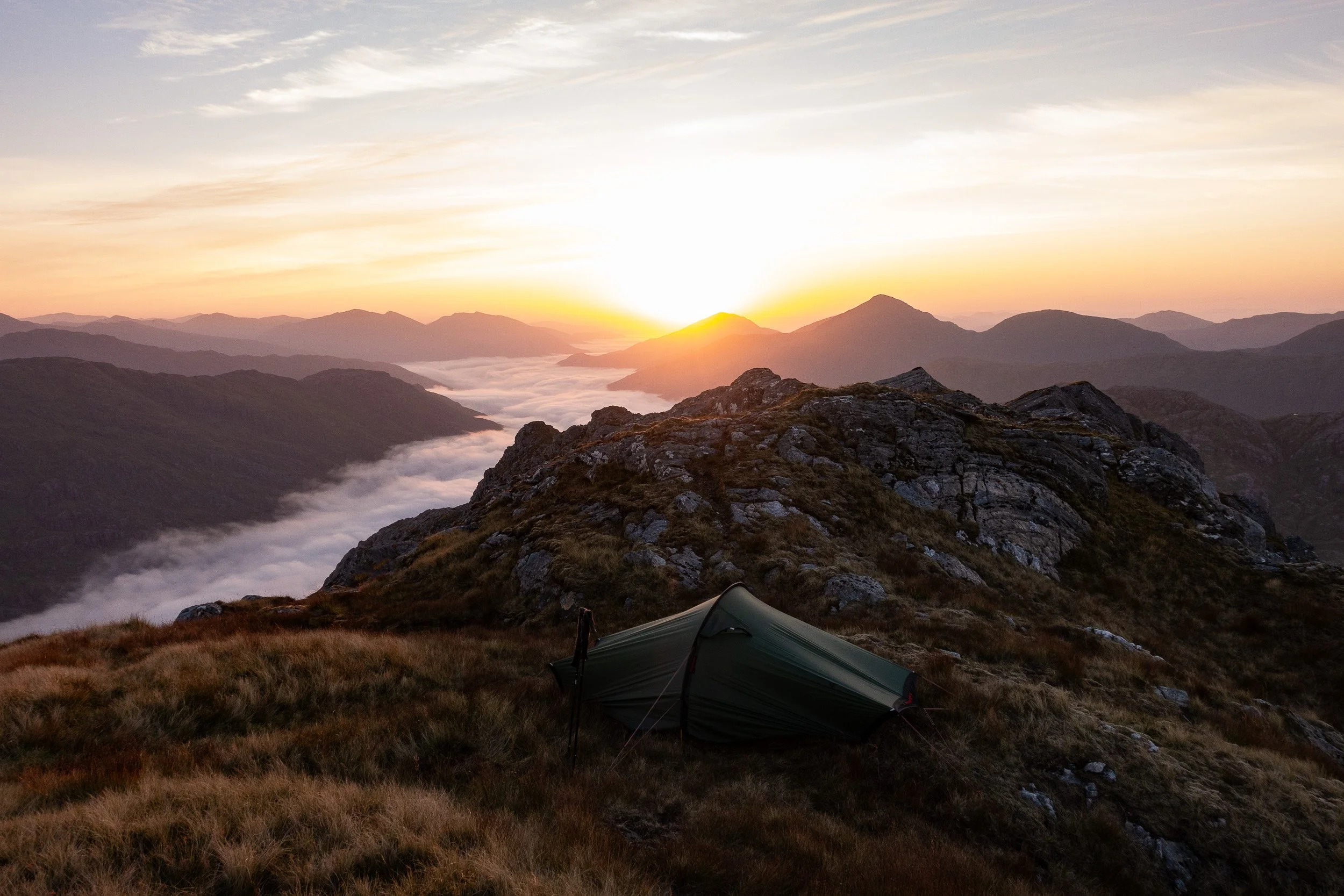
Wild camping in a tent above a cloud-covered Loch Cuaich (Quoich) at dawn from the summit of Beinn an Aodainn (Ben Aden) in the North-West Highlands of Scotland.
Despite not having high altitude, Scotland’s mountains and their maritime weather means that hypothermia is a real risk if you get soaked and chilled. Backpacking in Scotland can be a masterclass in compromise and whilst I imagine we all wish to experience warm sunshine and light winds as we travel with dry feet up remote glens and across rocky ridges, the reality of the Scottish Highlands - even between May and September - can be a relentless mix of bog, midges and ticks, sideways drizzle and strong wind gusts that will test every aspect of your clothing and equipment.
This is a kit list I’ve used for many years backpacking in Scotland over three seasons (Spring / Summer / Autumn) suitable for, say, the Cape Wrath Trail or the Skye Trail or 2-5 days Munro camping adventures - where my goal is to carry as little as possible, whilst still remaining safe, or to reduce the weight of what I do carry to the minimum (£ aside). It’s not an ultra light-weight backpacking kit list. Rather, it’s focused on durability, moisture management and keeping pack weight sensible without sacrificing safety and it includes small things that aren’t essential to take but which I’ve found are highly useful (such as e.g. a glasses case).
If you’re buying for a backpacking trip in Scotland, I’d suggest to focus on buying the best items you can afford - checking out second-hand options on e.g. eBay. And apply just as much consideration to your strength and fitness. Plus consider the value of everything you take (to you) versus the weight.
Wear
Underwear — A choice of lightweight synthetic or merino wool briefs, the latter of which I prefer for multi-day trips because the wool doesn't smell as much as synthetic fabrics after multiple days without a shower. It’s sensible to shy away from cotton - once it gets damp with sweat or rain, it stays damp and will chafe something terrible.
Trousers — I like trousers that dry quickly, helped by the wind. Popular choices on Scottish hills are lightweight, stretch-woven softshell trousers such as those by Montane (Terra series) and Mountain Equipment (Ibex). I have a similar pair from North Face that have a nice amount of stretch in them.
Socks — Bridgedale socks perfectly fit my size 11 feet. High-density and quick-drying wool, they provide both comfort and support.
Footwear — For a two to three-day trip I’ll consider trail running shoes, accepting that I’ll likely get wet feet. (Scarpa Spin Ultras I’ve found to be very comfortable). Waterproof socks can help but, personally, they make my feet very warm. A leather or synthetic boot gives better ankle support over the rough river crossings, tussocky grass and hillside traverses you’ll encounter in Scotland but almost certainly your feet will still get wet, through the big hole in the top. My advice would be to prioritise quick-drying fabrics and focus heavily on foot care. (Waterproof boots take ages to dry).
T-shirt — Hooded sun tops are popular in 2026 with the fabric providing protection from UV rays. I don’t have one, my choice being a simple short-sleeve base layer, which I’ll supplement with arm warmers if it’s colder or the sun is strong. Merino wool or synthetic again are my two choices of fabric, with merino wool managing odours better over a multi-day trek; synthetic fabrics drying quicker. Brands I’ve used include Artilect (M-Sprint), Patagonia (Capilene) and Montane (Dart). The arm warmers I prefer for three-season use are from Decathlon (Van Rysel brand).
Cap — A brimmed cap is handy to keep both the sun and sweat out your eyes plus it protects the crown of your head from the sun. A cotton baseball cap will work but a more pliable synthetic fabric I’ve found is easier to pack away when it’s not being used. Check out models from running brands such as Ron Hill, Inov8 and Vaga.
Backpack — A 50-litre rucksack I’d propose is an optimal balance between size and weight. If you need more, consider whether you really do - longer trips may warrant it as you’re carrying more food - or perhaps put some items in a waist pack). I like minimal features in a backpack plus side straps that enable me to attach my tent to the outside of my pack. Anything over 1.5kg I’d suggest is unnecessary heavy. In that regard, I rate Aiguille Alpine’s climbing packs which are very simple, have nothing unnecessary on them - hence they’re lightweight - and I find them super comfortable. (I use a customised Stratus version with a floating lid, which is 37+8 litres, or their Zenith model at 47+12 litres. Both packs are slightly larger than indicated, due to an XL back length).
Optional;
Extra pair of socks — A common tip is to carry an additional pair of socks for walking, which you rotate, drying one pair on your pack. Often though I’ve just ended up with two wet pairs of socks and I prefer just the one pair for walking, squeezing out the moisture as needed. If you have breathable footwear they’ll dry fairly quickly. Be mindful of blisters and take advantage of opportunities to remove your socks and shoes and air them.
Trekking poles (recommended) — Useful for saving your knees on steep descents, testing bog depth and maintaining balance during river crossings. I always bring them, prioritising lever-lock mechanisms over twist-locks, which I’ve found tend to slip when wet. Running poles are ideal (e.g. Alpkit Carbon Marathon Poles) but not as strong as dedicated hillwalking models. Careful use however should see them last a long time.
Gaiters — Personally, I’ve not worn gaiters outside of Winter for many years.
Warmth
For backpacking, there’s a fine balance I’d propose between clothing warmth and sleeping bag warmth. As in, it’s nice to have a warm jacket to stand around in, in camp, but if it’s too warm to walk in - and your sleeping bag’s appropriate for the conditions - you’ll be carrying more weight than you need. This is not always a bad thing. In cold, wet weather I far prefer having too much insulation rather than not enough.
Fleece top — A thin, lightweight fleece is useful, in all seasons. I like Mountain Equipment’s Lumiko model (the hooded version).
Insulated jacket — Imperative in Spring and Autumn (and in Scotland, often Summer). Buy one with a hood, which adds a lot of warmth, and ignore down fillings unless the forecast is stellar, given down collapses when wet. I’ve owned numerous synthetic insulated jackets over the years and found Primaloft Gold is very warm for its weight, Primaloft Silver not so much. The models that have stood out for me have been Rab’s Xenon Hoody, Haglöfs’ Barrier Zone Hoody and Rab’s Generator Alpine.
Hat — If I have a hooded fleece and a hooded insulated jacket, I’ll consider whether I also need a hat. If yes, Powerstretch fabric (used for hats and balaclavas) is light and warm. Rab’s Filament Beanie doesn’t use Powerstretch but I’ve found is also a good option, having different weights of fleece inside, the same as the Lumiko fleece above.
Gloves — Thin Powerstretch fleece gloves. They will get wet, but they retain warmth and dry quickly.
Optional;
Windshirt — A super-light Pertex windproof layer keeps the wind off without making you sweat like a hardshell does.
Buff — Useful for covering your face if it’s really wet, windy and cold.
Wet
For the lightest options, and in the nicest weather, look at running waterproofs such as those by Inov-8 or Montane (commonly using Pertex Shield). Just be aware of the risks - especially in colder weather - because in extended rain it’s very likely they will not keep you dry. Neither though will more expensive waterproofs - you’ll always get wet from the inside - but the latter will usually last much longer before wetting out with the thicker fabric offering more protection. Goretex Paclite I’ve found to be a good middle ground for a mixed forecast.
Waterproof top — The most protection would be a 3-layer Goretex hardshell (e.g. Mountain Equipment Lhotse, or similar models from Rab or Montane). Jackets made with Paclite Pro or the original Paclite are also suitable for three seasons. For all, look for a wire-brimmed, fully-adjustable hood that won't blow back off your head in a headwind and robust storm flaps over the zips. I also appreciate a decent-sized outside pocket, that will easily fit a map.
Waterproof trousers — Prioritise models with full or 3/4 side zips so you can put them on over boots without taking them off in a downpour. I’ve used Berghaus Paclite Pants for over a decade, across all seasons. Highly recommended.
Dry bags — Pack everything you want to keep dry inside your rucksack inside lightweight dry sacks (e.g. Sea to Summit or Exped). Years ago, I slept in a sodden wet sleeping bag and vowed I’d never again rely on a backpack rain cover to keep things dry.
Optional;
Waterproof shell mitts — If it’s forecast to be cold and wet, I’ll bring Goretex Paclite mitts from Extremities (Tuff Bags) which offer good wind / waterproof protection in a lightweight package.
Hydration and nutrition
Water bottle — Treadlite Gear’s bottle pouches are really useful for carrying water up front on a backpack, mimicking the functionality of a running pack (which enables you to access your water bottles without taking your pack off). I’ll carry x2 600ml Smart water bottles plus electrolyte tablets from Sports in Science or Nuun. As a bonus, the electrolyte tablets are fizzy and taste very nice.
Food — For backpacking, I like simple, easily repeatable meals. I have used the following for many years. (To add some variety, refer to this Reddit thread on backpacking meal ideas). The bags they’re packed in double as rubbish bags.
Breakfast - Granola cereal and skimmed milk powder. Just add water.
On the move / lunch - If I’m on my own, I’ll generally just graze throughout the day on calorific treats rather than stopping for lunch; carrying a mixture of texture and taste such as e.g. M&Ms, raw fruit & nut bars, fudge pieces, wasabi-coated peas, etc. If I’m with others, I’ll take a roll or oatcakes with cheese or vegetarian pate for lunch and less snacks. Jelly beans make it into my pack regardless and are much welcomed at the end of a long day, by both me and my companions.
Dinner - Packet soup (minestrone) plus this Rice and Beans recipe from Andrew Skurka which is light and super tasty. Doritos is a good replacement for the Fritos, sealed from the air for freshness, and I’ll use parmesan cheese if I’m out for more than two nights. (Santa Fe instant beans are available in the UK from Shayona). More expensive mealtime options are freeze-dried meal pouch options (e.g. Summit to Eat, Firepot), available in outdoor shops and online from e.g. Base Camp Food. For dessert, I’ll carry some small chocolate bars, valuing the simplicity of Cadbury’s Freddo Frogs, despite being in my mid-fifties.
Safety
Navigation — Map and compass. Ordnance Survey (1:25k or 1:50k) or Harvey Maps covering your route, protected in an Ortlieb waterproof map case. Don’t rely solely on a mobile phone. A lot of the Scottish Highlands has poor cellular connection (in my experience, with O2) and its best to know where you are without having to check a computer.
Mobile phone — If I’ve not chosen to use it as a camera, I’ll keep my phone switched off and stored in a dry bag. Downloaded onto it is the Sarloc mobile app, developed by Russ Hore, a former Mountain Rescue team member. I’ve also registered my phone for calling 999 by text, i.e. emergency SMS. The iOS version on my phone also enables emergency SMS functionality.
Headtorch — I’m not expecting to be navigating in the dark when camping but I still want to be able to do so if needed so I’ll carry a Petzl Bindi head-torch, which I’ve found to be a great balance between weight and usability.
Optional;
Mobile apps — I like the OS Maps app from Ordnance Survey, which I’ll use as a backup to my map and compass. It’s not perfect - I’ve commonly found tiles which are out of date compared to e.g. Walk Lakes GPS mapping software.
GPS Watch / Navigation — A modern smart watch (e.g. Garmin Fenix) is capable of tracking OS grid references, distance and elevation, which is very useful, and I use mine all the time, but I don’t class it as essential - outside Winter anyway - given it isn’t my sole method of navigation.
Messaging device — A satellite messenger (such e.g. Garmin inReach). I’ll always carry one but it’s not 100% essential given my phone has the functionality too. I prefer though redundancy in equipment, especially when I am out on my own.
Powerbank (Recommended) — I use Nitecore’s 10,000 power brick, which is light and powerful.
Cables — I’ll carry a USB-C, USB-A plus a Garmin adapter for my watch.
Personal care
Suncream — Sunburn is not a good look, nor good for health. I’ll apply factor 50 liberally, throughout the day, being conscious to cover my lips and ears as well as my face and neck.
Sunglasses — Possibly optional (I’ve never carried any in 25 years of backpacking).
Insect protection — Protection from midges is essential in Scotland. A fine mesh head net (specifically a midge net, as mosquito nets let them right through) and Smidge spray does the trick, along with tucking your socks into your trousers and wearing your gloves. Other annoying insects are ticks (yeuch), prevalent in long grass and bracken, and deer ked (double yeuch) and horsefly. I’ll always carry tick tweezers when camping.
First aid kit — Not as big a first aid kit as in Winter but enough to cover e.g. blisters, burns and bites. (Mine includes strong painkillers, loperamide, zinc oxide tape and antiseptic wipes).
Toiletries — Toothpaste tablets and a brush, toilet paper, soap, lighter and a trowel.
Sleeping
Tent, poles and pegs — Popular in 2026 are tents that accommodate trekking poles instead of tent poles. This could save you c.300 grams (an approximate weight of two aluminium poles) as long as you’re already carrying trekking poles. What happens though if you damage a pole? (I’ve broken a lot of trekking poles). I appreciate it’s unlikely you’d break two. Expensive such tent models include Thurston and Hyperlite Mid but see also Simond for a cheaper option. I hiked the Cape Wrath Trail - most of it anyway - with a 1-man tent from Argos, which cost me £29.00 - 50% off in a sale. It was said to be a direct copy of a much more expensive Sierra Designs model and it was excellent until I retired it due to the weatherproofing coming to the end of it’s life. In it’s place, I purchased a Hilleberg Akto tent which I really like and use all year round.
Sleeping bag — I spent four days on a backpacking trip in Scotland in May in a one-season down bag which I thought would be warm enough but proved not to be when I woke up every night 2 to 3 hours after going to sleep (and sometimes 2 to 3 hours after that) due to the cold. I vowed not to scrimp on a sleeping bag ever again (although one one winter camp atop the summit of a Munro above Glenfinnan had me questioning my decision-making as I lay in my sleeping bag with my thickest insulated jacket on and I was only just warm enough without moving). A synthetic bag or a hydrophobic treated down bag rated to around 0°C to -3°C I’d suggest is ideal for Spring and Autumn. It’s not overly heavy for Summer.
Sleeping mat — Ground temperature saps body heat and an appropriate rated (R-value) sleeping mat makes a big difference. Cascade Designs’ Thermarest models are expensive but totally worth it, in my opinion. I use a X-Therm which is overkill outside Winter but I’m still happy to use it all year round because it is smaller and lighter than a three-quarter sleeping mat I had previously. If I was starting again. I’d likely look Therm-a-Rest’s NeoAir XLite (and carry a Ridgerest for Winter if I felt it was needed).
Cooking — Stove, gas, pot, lid, spoon - Alpkit’s Kraku stove is tiny and I’ve found it perfect for three seasons. It replaced an MSR Pocket Rocket, the second version of which fits neatly into a cooking pot. Imperative I’d propose - to keep the flame on and optimise gas - is a windbreak such as the Optimus clip-on windshield. (Research this fully if you want to use one - you don’t want to be fully enclosing a canister-mounted stove from the wind, for safety reasons). Pot-wise, I’ve had a long-term camping relationship with an MSR Titan kettle which is super expensive but will outlast me (cheaper options are available from Alpkit and eBay) and a Light my Fire titanium spoon which cost £18 at the time - for a spoon! - but is very nicely designed. Plastic spoons are also available. For fuel, a 100gm gas cartridge will last me 4 days or more, regardless of season.
Spare clothes — Arguably these are optional for Summer but the minimum I’d propose for Spring / Autumn, for comfort and safety reasons, would be spare underwear (e.g. Rab Syncrino), a lightweight pair of leggings (Patagonia Terrebonne Joggers are ideal), wool socks and a base layer. Pack these in a dry bag, along with your sleeping bag.
Optional;
Repair kit (Recommended) — Things always seem to fail when you least want them to (e.g broken laces, punctured sleeping mat, broken tent pole). Consider how you’ll fix the key things that matter to you and carry the means to be able to. Focus on the highest risks; you don’t need to carry the means to fix everything (but you’ll be frustrated when the thing that breaks is the thing you don’t have any repair items for. In that case, you’ll need to be resourceful).
Water filter / purification — A lightweight squeeze filter (Katadyn BeFree)
Kindle — Or a similar electronic reading device. You can use the app on your phone (useful for podcasts too) but, batteries. Or perhaps not read at all.
Microfibre cloth — A small piece of cloth, useful for drying the inside of your tent floor if it’s been raining or the ground has been wet.
Glasses case — A light plastic case. I’ve bent many a pair of glasses from rolling over onto them.
Water — A 2-liter collapsible bladder for camp. Highly recommended for summit camping as you need to carry more water up the hill.
Photography
I’ll use my mobile phone more for photography in Spring, Summer and Autumn than I would outside of winter, as the battery lasts longer (I’m not simply carrying my phone for safety). Not in the wet though as the touch screen isn’t reliable when it has water on it. No matter what the weather though, it’s unlikely I’ll take my professional camera gear when backpacking - unless perhaps camping on a summit - and my happy medium for photography is Sony’s RX100 compact camera, which is ideal for me in regards to quality versus weight.
Mountain safety
If you’re new to the outdoors, ensure you have the skills to be able to cope. Mountaineering Scotland offer resources and courses to help you on your way, such as;
Leave no trace
Your goal should be to leave the outdoors as you found them and protect the environment for future generations. Support this by following these seven Leave No Trace principles.
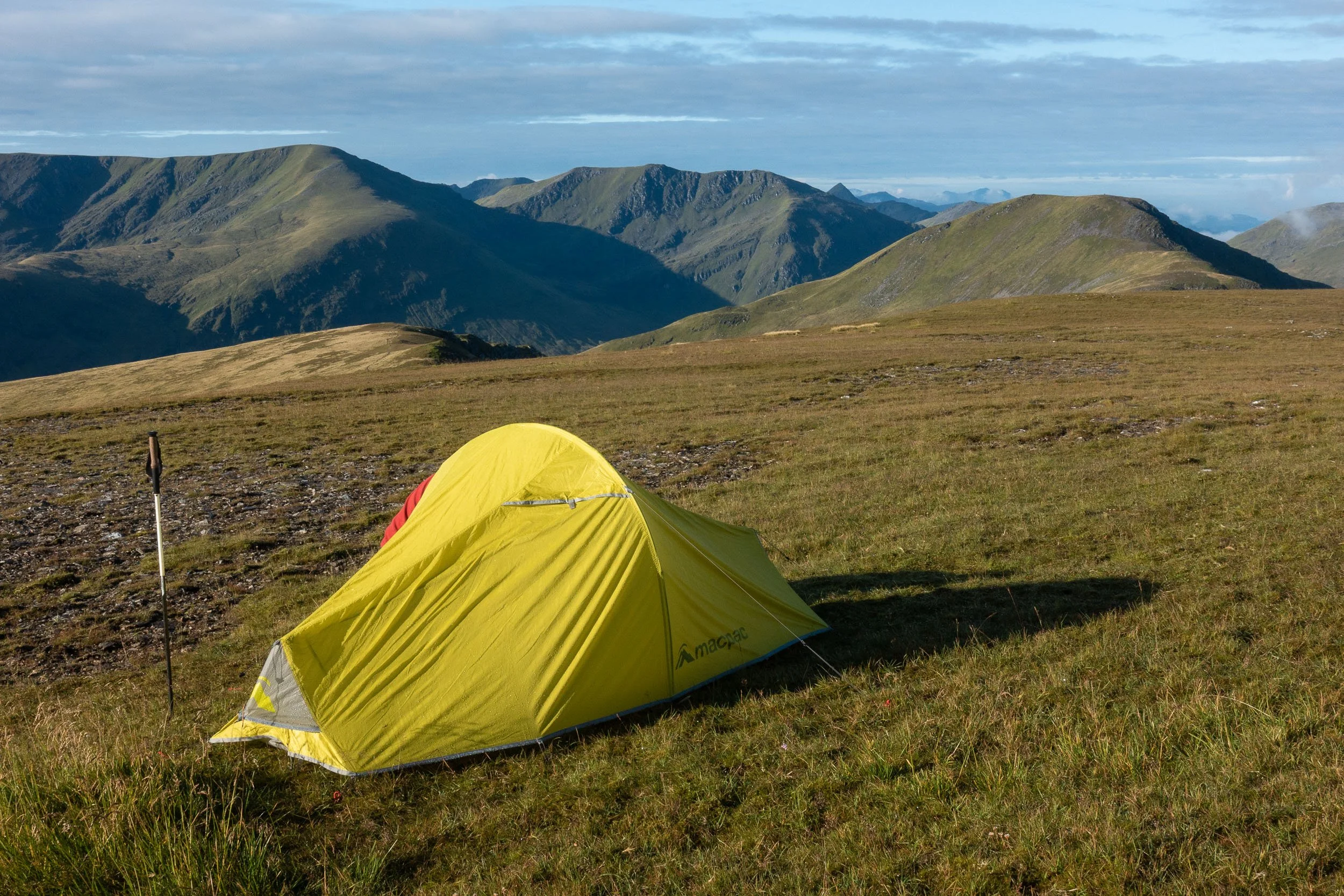
Perfect ground for backpacking near the summit of Moruisg in the North-West Highlands of Scotland. We’d wild camped the previous evening on a bealach in the distance and this was our third (and last) Munro of the day. My tent is pitched just behind me.